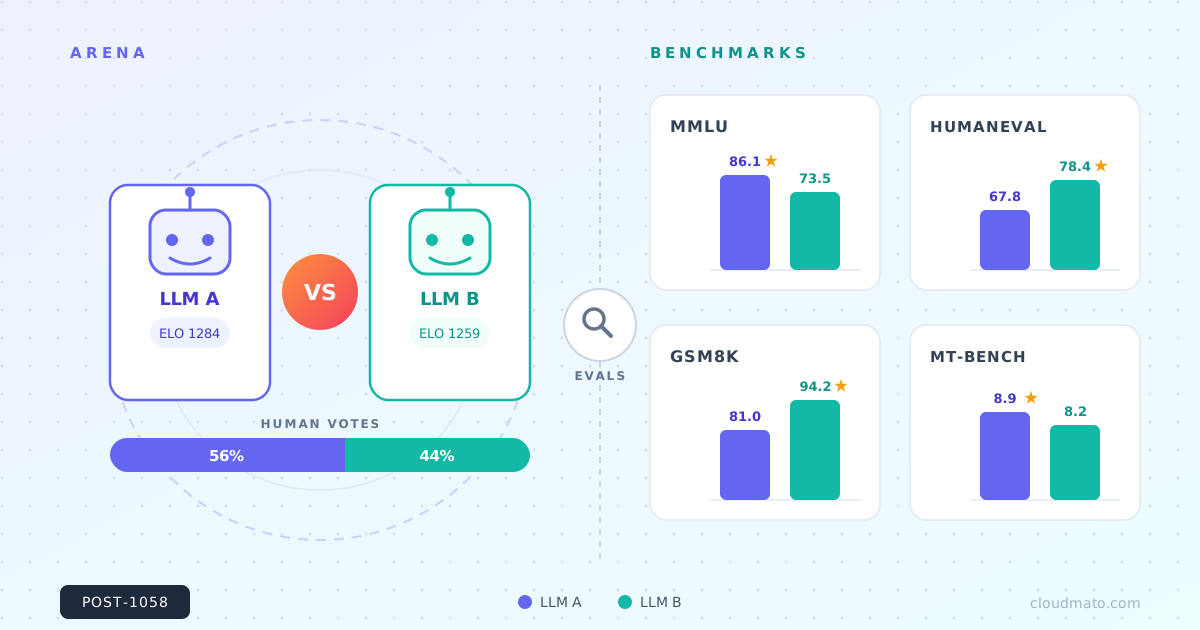
Every couple of weeks some AI lab drops a new model and immediately claims it’s the smartest thing on the planet. Then another lab does the same thing a week later. If you’ve ever tried to figure out which one is actually better, you’ve probably stared at a wall of charts with names like MMLU, GPQA, and SWE-bench and felt your eyes glaze over. I went down this rabbit hole recently, and here’s the short version: there’s no single scoreboard. There are at least four completely different ways people measure “better,” and once you know what each one is actually doing, the whole AI leaderboard circus starts to make a lot more sense.

Everyone talks about ChatGPT and Claude like they just appeared one day. You type something, you get an answer, magic. But have you ever stopped to ask what it actually takes to make one of these things? Not the chat interface — the model itself. The thing that took months, hundreds of millions of dollars, and enough electricity to power a small town.
I’ve been curious about this for a while, partly because the numbers are genuinely hard to believe until you sit with them. So I went digging through what’s actually known — the leaked architecture details, the hardware announcements, the data center buildouts. Some of it is public, some of it is well-sourced speculation, and some of it the labs keep deliberately vague. Let me walk you through what we actually know.

Ask three people what “loop” means in AI right now and you’ll get three different answers. One will say the agent loop. Another will start talking about model collapse and feedback loops. A third will mention human-in-the-loop from some compliance meeting. They’re all correct, which is exactly why the word has become so confusing.
I’ve been writing software for over 8 years, and I’ve watched plenty of jargon get recycled. But “loop” is special because it’s not one trend — it’s at least four different ideas that all happen to share the same word, and all of them got hot at roughly the same time. So let me untangle them.
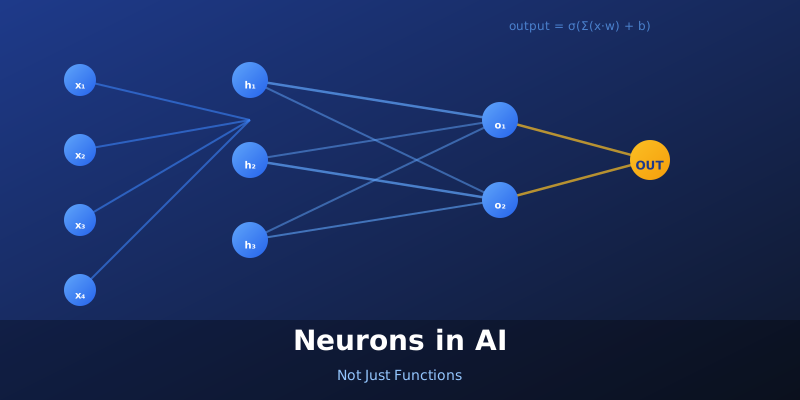
If you’ve heard “neural network” thrown around in tech circles, you probably imagined something biological. The term neuron can make beginners think they need to understand brain biology to work with AI. They don’t. But the confusion about what a neuron actually does — and how it differs from a function you’d write in code — is real. And that difference matters [1][2].
What’s a Neuron, Really? A neuron in AI is a computational unit. Stripped down, it’s a thing that takes inputs, does math, and produces an output. Sounds like a function, right? It kind of is. But that’s where the similarity ends.