
Most developers lump all indexes together — “just something that makes queries fast” — without understanding that Elasticsearch and Oracle DB are solving completely different problems. They index the same data in fundamentally opposite ways, and that difference shapes everything about how they perform.
Let me show you why a full-text search on Oracle feels like pulling teeth, while Elasticsearch makes it look trivial.
The Core Problem: Two Different Use Cases Oracle databases are built to answer questions like: “Give me the row where user_id = 5” or “Find all orders between January 1 and January 31.” Exact matches and range queries. The data is structured, indexed by column, and queries are usually precise.
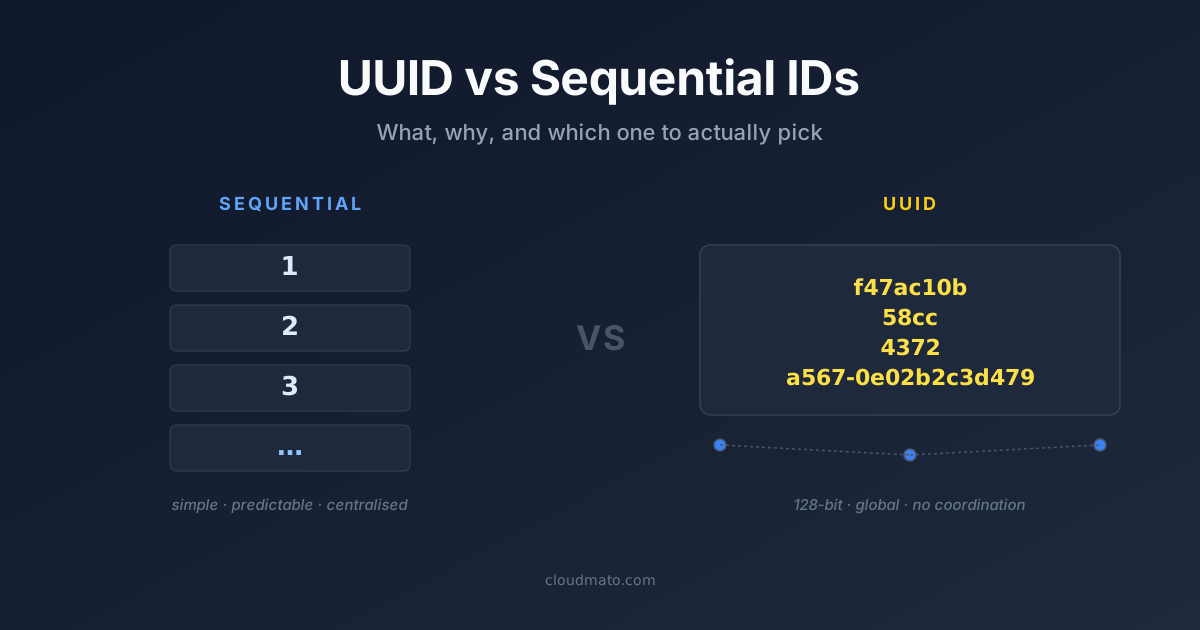
You expose an API endpoint like /api/orders/1042. That integer tells anyone listening — a competitor, an attacker, a curious user — exactly how many orders you have. Change the number to 1041, you get the previous order. Change it to 1, you get the very first one. No auth bypass needed. The ID itself is the information leak.
That’s the sequential ID problem in one paragraph. UUID exists to fix it — and a few other things that matter at scale.