
I kept hearing “use WebSockets for real-time stuff” without anyone explaining what actually happens on the wire. So I went and read the RFC, poked at a few servers, and figured I’d write down what I found — including the part that confused me the most: whether WebSocket is a protocol of its own or just some clever trick on top of HTTP.
So what is a WebSocket?
A WebSocket is a persistent, full-duplex communication channel between a browser (or any client) and a server, opened over a single TCP connection [1]. Full-duplex means both sides can send messages whenever they want — not just in response to a request. That’s the part that breaks the usual mental model of the web.
Compare that to how you’ve probably been thinking about web traffic your whole career:
- Client sends a request.
- Server sends back a response.
- Connection (logically) closes or sits idle until the next request.
With WebSockets, once the connection is open, either side can push data at any moment — no request needed first. The server can message you the instant something happens, instead of waiting for you to ask “anything new?” [2].
Are WebSockets a protocol? Yes — and it’s a real standard
This is the bit I was genuinely unsure about. WebSocket is not a JavaScript trick or a library feature — it’s a standardized protocol, defined in RFC 6455 by the IETF in 2011 [1][3]. It has its own URI schemes too: ws:// for plain WebSocket traffic (default port 80) and wss:// for WebSocket over TLS (default port 443, the encrypted version you should actually use in production) [1].
In terms of where it sits in the stack: both HTTP and WebSocket are application-layer (Layer 7) protocols that run on top of TCP (Layer 4) [4]. So WebSocket isn’t replacing TCP or competing with HTTP at a fundamental level — it’s a sibling protocol to HTTP that happens to start its life by speaking HTTP.
“The WebSocket Protocol enables two-way communication between a client running untrusted code in a controlled environment to a remote host that has opted-in to communications from that code.” — RFC 6455 [3]
That “opted-in” phrasing matters — a server has to explicitly agree to switch protocols. Which brings us to the handshake.
The handshake: how an HTTP request turns into a WebSocket
This is the cleverest part of the design, and honestly the reason WebSockets work as well as they do across the existing internet. Instead of inventing a brand-new connection mechanism that firewalls, proxies and corporate networks would all need to learn about, WebSocket bootstraps itself through an ordinary HTTP request using the Upgrade header [5][6].
Here’s the actual sequence:
- The client sends a normal-looking HTTP
GETrequest, but with extra headers:Upgrade: websocket,Connection: Upgrade, and a randomly generatedSec-WebSocket-Key[1][6]. - The server, if it supports WebSockets, responds with
HTTP/1.1 101 Switching Protocols, echoingUpgrade: websocketandConnection: Upgrade, plus aSec-WebSocket-Acceptheader [6]. - That
Sec-WebSocket-Acceptvalue isn’t arbitrary — the server takes the client’s key, appends a fixed “magic” GUID (258EAFA5-E914-47DA-95CA-C5AB0DC85B11), runs it through SHA-1, and base64-encodes the result. This proves the server actually understood the WebSocket request rather than some random server just echoing headers back [6]. - From this point on, the same underlying TCP socket stops speaking HTTP entirely and starts exchanging WebSocket frames — a lightweight binary framing format with as little as 2-6 bytes of overhead per message, supporting text frames, binary frames, and control frames (ping/pong/close) [2][1].
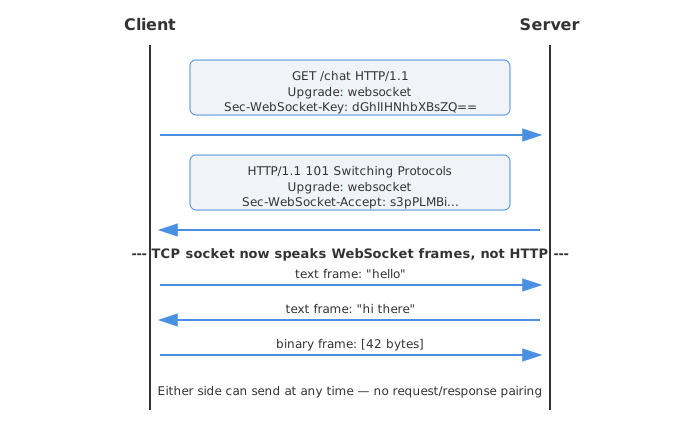
Once that handshake is done, the connection is no longer “an HTTP connection that happens to do something special.” It has fully become a WebSocket connection — same TCP pipe, completely different protocol running over it.
WebSocket vs HTTP — the actual differences
Here’s where it gets interesting, because the two protocols solve fundamentally different problems even though one bootstraps the other.
| Aspect | HTTP | WebSocket |
|---|---|---|
| Communication model | Request–response, client always initiates [2] | Full-duplex — either side sends anytime [1][2] |
| Connection lifetime | Short-lived; opened and closed per exchange (or pooled/reused) [2] | Persistent; stays open after the handshake until explicitly closed [2] |
| Per-message overhead | Hundreds of bytes of headers on every request/response [2] | As little as 2–6 bytes of frame overhead [2] |
| Statefulness | Stateless by design — each request stands alone | Stateful — the server keeps the connection (and often session context) alive [4] |
| Server-initiated push | Not natively possible; client must ask | Native — server can push the moment data is ready [2] |
| URI scheme | http://, https:// | ws://, wss:// [1] |
| Underlying transport | TCP (Layer 4), itself Layer 7 | Also TCP (Layer 4), also Layer 7 [4] |
The big one is “who’s allowed to start talking.” In HTTP, the server can never just message you — it has to wait to be asked. That’s why apps that need live updates over plain HTTP resort to workarounds like polling (asking “anything new?” every few seconds) or long-polling (asking and having the server hold the request open until something happens). Both work, but they waste bandwidth on empty responses and add latency proportional to your polling interval [7].
WebSockets remove that constraint entirely. Once the handshake completes, the server can shove a message down the pipe the instant something happens — no polling, no waiting, no wasted “nothing new” round trips [7].
When you’d actually reach for WebSockets
I’ll be honest — for most CRUD apps and dashboards that refresh every few seconds, plain HTTP with polling or long-polling is simpler to run and good enough [7]. WebSockets earn their complexity when the frequency and direction of updates make request-response awkward:
- Chat applications — messages from any participant need to reach everyone else in near real time, and the standard approach here is WebSockets for good reason [7].
- Multiplayer gaming — game state often needs to sync 20–60 times per second; nothing else gets close to the per-frame efficiency of a persistent socket [7].
- Collaborative editing — every keystroke needs to propagate with minimal delay (think Google Docs-style tools).
- Financial trading / live price feeds — sub-100ms updates with the ability to submit orders on the same connection [7].
- Live notifications and dashboards that genuinely need second-by-second pushes rather than periodic refreshes.
If your “real-time” requirement is actually “update every 30 seconds is fine,” don’t reach for WebSockets just because it sounds modern. The trade-off is real — WebSockets need you to manage connection state, reconnection logic, and scaling thousands of long-lived sockets, which is a meaningfully different operational burden than stateless HTTP servers behind a load balancer [7].
A quick note on encryption
Just like HTTP has HTTPS, WebSocket has wss://, which runs the WebSocket protocol over TLS [1]. There’s no good reason to ship ws:// in production — use wss:// the same way you’d refuse to ship a login form over plain http://. The handshake still starts as an HTTPS request before upgrading, so you get the same certificate-based trust model you’re already used to.
Wrapping up
WebSocket isn’t a hack bolted onto HTTP — it’s its own IETF-standardized protocol (RFC 6455) that simply uses HTTP’s Upgrade mechanism as a polite way to ask “can we switch to something better suited for this conversation?” [1][3][6]. Once the server says yes with a 101 Switching Protocols, you’re no longer in HTTP-land at all — you’re exchanging lightweight frames over a connection that stays open and lets both sides talk whenever they need to [6][2].
Whether you actually need that is a different question than whether it sounds cool. For most things, you don’t. For chat, games, and live collaborative tools, you very much do.
Sources
- WebSocket Protocol: RFC 6455 Handshake, Frames & More — WebSocket.org
- WebSockets vs HTTP: Key Differences Explained — Postman Blog
- RFC 6455 — The WebSocket Protocol (RFC Editor)
- What is a WebSocket? — IP With Ease
- Protocol upgrade mechanism — HTTP — MDN Web Docs
- Writing WebSocket servers — Web APIs — MDN Web Docs
- Long Polling vs WebSockets: Choosing the Right Transport for Real-Time Feeds — GetStream