I remember the first time I switched a project from CRA (which uses Webpack under the hood) to Vite. The dev server came up in under a second. I genuinely stared at the terminal for a moment, waiting for something else to happen. Nothing did. That was it — it was ready. That’s not a small improvement over Webpack. It’s a completely different experience.
What Is Vite?
Vite (French for “fast”, pronounced “veet”) is a frontend build tool created by Evan You — the same person who built Vue.js [1]. It launched in 2020 and has been growing fast. As of 2025, Vite logs 53 million weekly npm downloads against Webpack’s 36 million [5]. Its GitHub stars tell the same story: 78,000 vs Webpack’s 66,000 [5].
Every build tool has two core jobs:
- Serve your code during local development with hot module replacement (HMR)
- Bundle and optimize the output for production
Both Vite and Webpack do both. The how is completely different — and that difference is why one of them starts in milliseconds and the other makes you wait.
Why Webpack Gets Slow
Webpack’s approach is simple but expensive: bundle everything first, then serve. Before the browser sees a single pixel, Webpack reads every file in your project, resolves every import chain, compiles everything, and outputs one big bundle.js. A medium-sized React app can take 15–30 seconds just to cold-start [1].
This made sense in 2014. Browsers back then couldn’t handle ES modules natively — you had to hand them one pre-processed file. Webpack was built for that world. The problem is it’s still largely working the same way, even though browsers have supported native ESM for years.
HMR is the other pain point. When you change one file, Webpack partially rebuilds the bundle. On big projects, even small edits can take 2–5 seconds before you see the change. That feedback loop kills focus.
The configuration complexity is a whole other problem. I’ve inherited Webpack configs that were 400+ lines long, stacked with loaders, plugins, and environment-specific overrides that nobody fully understood anymore. According to the State of JavaScript survey, 86% of developers still use Webpack, but only 14% actually like it [8].
How Vite Actually Works
Vite makes one fundamental bet: modern browsers understand ES modules natively, so don’t bundle during development.
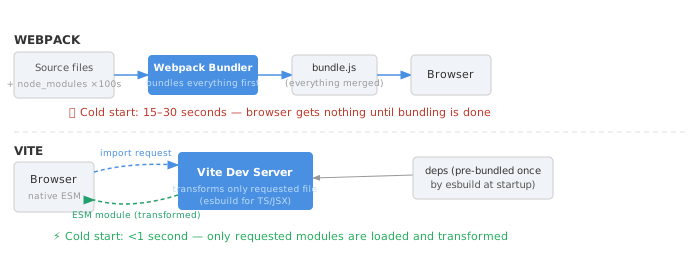
When the browser encounters an import in your code, it fires a request to the Vite dev server. Vite intercepts that request, transforms just that one file (TypeScript, JSX, whatever) using esbuild — a bundler written in Go that’s roughly 10–100× faster than JavaScript-based equivalents — and returns it [3].
There’s one catch: third-party packages in node_modules are often CommonJS, not ESM. And some libraries have hundreds of internal imports that would create hundreds of HTTP requests. So Vite pre-bundles dependencies once at startup using esbuild, converts them to ESM, and caches them. This step takes milliseconds [1]. After that, your app source files are served on demand — no bundling step at all.
HMR in Vite stays fast as the project grows. When you change a file, Vite invalidates only that module and its direct dependents. It doesn’t touch anything else. The HMR boundary logic is precise. This is why Vite’s HMR feels instant in a 10-file project and still feels instant in a 500-file project — unlike Webpack, where HMR speed degrades as the codebase scales [3].
Vite vs Webpack — Side by Side
| Vite | Webpack | |
|---|---|---|
| Dev server cold start | < 1 second | 15–30s (medium app) |
| HMR speed | Instant at any scale | Degrades with project size |
| Config to start | ~10 lines | Often 100s of lines |
| Production bundler | Rollup / Rolldown | Webpack |
| Bundle size (avg) | ~130 KB | ~150 KB |
| Weekly npm downloads | 53 million | 36 million |
| Best for | New projects, modern stacks | Legacy apps, enterprise, custom loaders |
Sources: [2][5]
Shopify migrated several internal tools from Webpack to Vite and went from a ~12 second startup to under 800 milliseconds [2]. That’s not optimization. That’s a different architecture.
Vite 8 and Rolldown — The Next Step
Vite has always had a split personality: esbuild for development transforms, Rollup for production builds. They’re different tools with different behaviors. This occasionally caused subtle bugs — things that worked in dev but broke in production, or vice versa.
That’s now being addressed with Rolldown — a Rust-based bundler developed by VoidZero (Evan You’s company) built to replace both [6]. Vite 8, released in 2026, ships with Rolldown as the default production bundler, giving both dev and prod builds the same underlying engine [7].
Early production build results:
- Excalidraw: 22.9s → 1.4s (16× faster) [8]
- GitLab: 2.5 minutes → 40 seconds [8]
- General benchmark claims: 10–30× faster production builds vs the previous Rollup pipeline [7]
The dev/prod parity problem also goes away. That’s been an underrated source of bugs for years.
Will Vite Eventually Become Like Webpack?
This is what everyone’s thinking but not saying directly. Webpack didn’t start out as the monster it became. It grew. Teams added loaders, wrote custom plugins, layered environment-specific overrides, and left legacy workarounds that nobody dared remove. Twenty config files and one senior engineer who “knows the build setup” — which every mid-sized company has experienced.
Can Vite follow the same path? Honestly, to a degree — yes. Big teams will build big configs. SSR setups already have edge cases. Enterprise projects will push the new Environment API in Vite 6+ in ways that require deep Vite knowledge [5].
But there’s a structural reason it probably won’t get as bad. Webpack’s complexity was largely accidental — compatibility layers for old browsers, CommonJS-to-ESM conversions, a thousand plugins patching edge cases that native tooling has now solved. Vite sidesteps most of that by simply requiring modern environments. That cuts off an entire category of “I need a custom loader for this weird legacy thing.”
Vite’s plugin system is a deliberate superset of Rollup’s API [1]. Rather than inventing a new config format, it reuses a well-understood interface. That’s a good sign — it means ecosystem knowledge transfers rather than accumulating in isolation.
The complexity that Vite will accumulate will mostly be intentional — advanced users building custom SSR pipelines, multi-environment setups, or framework-level tooling. That’s a different kind of mess. You can usually still understand a Vite config you didn’t write. The same cannot be said for most inherited Webpack configs I’ve touched.
Whether Vite in five years looks as scary as Webpack does today — I doubt it. But “not as bad as Webpack” still leaves a lot of room.
End
Sources
- Why Vite — Vite Official Docs
- Vite vs. Webpack for React Apps in 2025: A Senior Engineer’s Perspective — LogRocket
- Vite’s Core Magic: How esbuild and Native ESM Reinvent Frontend Development — Leapcell
- Vite vs. Webpack: A Head-to-Head Comparison — Kinsta
- Webpack vs Vite: Choosing the Right Bundler for Modern Frontend Development — Syncfusion
- Announcing Rolldown-Vite — VoidZero
- Vite Version 8: Unified Rust-Based Bundler and Up to 30x Faster Builds — InfoQ
- Rolldown-Vite Beta: Rust-Powered Bundler Cuts Build Times by Up to 16× — Progosling