
Every time someone asks me “should I use sessions or JWTs?”, I know what’s actually behind the question. They’ve read a few blog posts, seen the word “stateless” thrown around like it’s automatically better, and now they’re stuck. So let’s settle this properly - not with buzzwords, but with what’s actually happening on the wire and on your server.
Sessions: the “we keep a record at the front desk” approach
Think of session-based auth like checking into a hotel. You show your ID once at the front desk, the staff verifies it, and they hand you a room key card. That card doesn’t contain your name, your passport number, or your booking details - it’s just a random number. The hotel’s computer system has all your actual information stored in their database, linked to that card number.
That’s exactly how session-based authentication works:
- You log in with your username and password.
- The server checks your credentials, creates a session record (your user ID, roles, login time, etc.), and stores it server-side - in memory, a database, or something like Redis [2].
- The server generates a random session ID and sends it back as a cookie, usually with the
HttpOnlyflag so JavaScript can’t touch it [3]. - On every subsequent request, your browser automatically attaches that cookie.
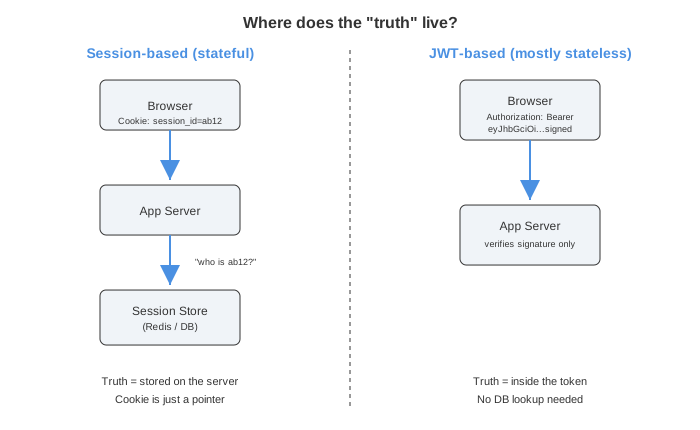
- The server takes the session ID, looks it up in its session store, and goes “oh right, this is Amit, he’s logged in, here’s his data.”
The important thing here: the session ID itself means nothing. It’s just a pointer. All the actual “truth” - who you are, what you can do - lives on the server [1]. If the server’s session store goes down or gets cleared, every logged-in user gets kicked out instantly, even though their cookie is technically still valid.
This is why session-based auth has been the default for traditional server-rendered web apps for decades. It’s simple, it’s well understood, and revoking access is trivial - just delete the row from the session table.
JWTs: the “show your ID badge every time” approach
Now imagine a different system - instead of a room key that points to a database record, you get a laminated badge. That badge has your name, your photo, your access level, and a tamper-evident hologram printed right on it. Anyone with a UV scanner can verify the hologram is genuine without calling back to the front desk.
That’s a JSON Web Token (JWT). A JWT is a self-contained, digitally signed string made up of three parts separated by dots: header.payload.signature [4][5].
- Header: tells you the token type (
JWT) and which algorithm was used to sign it, likeHS256orRS256[5]. - Payload: the actual claims - things like
sub(user ID),role,iat(issued at), andexp(expiry time). This is just Base64Url-encoded JSON, not encrypted, so don’t put secrets in here [5][9]. - Signature: the header and payload, hashed and signed with a secret key (or private key). This is what proves the token hasn’t been tampered with [4].
A decoded JWT payload might look something like this:
{
  "sub": "user_8821",
  "name": "Amit Kumar",
  "role": "admin",
  "iat": 1748505600,
  "exp": 1748509200
}
Here’s the part that throws people off: the server doesn’t store this anywhere. When you log in, the server signs this payload and hands you the whole thing. On your next request, you send the token back (usually in an Authorization: Bearer <token> header), and the server just re-checks the signature. If the signature is valid and the token hasn’t expired, the server trusts everything in the payload - no database lookup needed [6][1].
You can poke around with real tokens yourself on the jwt.io debugger - paste in any JWT and it’ll decode the header and payload for you instantly [4].
The core difference: where does the “truth” actually live?
Okay, here’s the bit that actually matters, and it’s the answer to the question in the title.
With sessions, the truth lives on the server. With JWTs, the truth travels with the client.
Everything else - cookies vs headers, scalability debates, revocation headaches - is a downstream consequence of this one architectural decision. Session auth is stateful: the server has to remember something about you between requests. JWT auth is (mostly) stateless: each request carries everything the server needs to make a decision, and the server just verifies a cryptographic signature [6][1].
This single difference cascades into pretty much every practical trade-off you’ll hit. A request that needs a session lookup costs roughly 15ms against a Redis or database store, while verifying a JWT signature costs around 20ms but skips the storage round-trip entirely - and at scale, JWT-based systems have been benchmarked handling around 1M requests/sec across distributed servers versus roughly 500K req/sec for centralized session stores [11]. That’s not a small gap when you’re operating at scale.
The revocation headache nobody mentions until it’s a problem
Here’s where it gets tricky, and honestly, this is the part most “JWT is better!” articles gloss over.
With sessions, logging a user out is instant. You delete their session record from the store, and the next request with that cookie fails immediately. Need to force-logout everyone because of a security incident? Wipe the session table. Done [2].
With JWTs, there’s no session record to delete - that’s the whole point of statelessness. Once a JWT is signed and handed to the client, the server has no built-in way to “take it back.” It remains valid until it expires, no matter what happens afterward [7][8]. Even if a user resets their compromised password, or an admin deactivates their account, a previously issued JWT can keep working until its exp claim says otherwise [8].
This isn’t a hypothetical edge case. Redis’s own engineering team wrote a piece literally titled “JSON Web Tokens (JWT) are dangerous for user sessions”, making the point that the statelessness which makes JWTs attractive is the same property that makes them risky for anything resembling a traditional login session [7].
So how do real systems deal with this? A few patterns have become standard:
- Short-lived access tokens (5-15 minutes) paired with longer-lived refresh tokens. If an access token leaks, the damage window is small [8].
- Refresh token rotation with token families - each refresh issues a new refresh token, and if an old, already-used one shows up again, the whole family gets revoked (a strong signal of theft) [8].
- Denylists - keeping a server-side list of revoked token IDs (the
jticlaim) in something like Redis with a TTL matching the token’s expiry [8].
Notice something? Every single one of these “fixes” reintroduces a bit of server-side state. So in practice, pure stateless JWT auth is mostly a myth once you need real-world logout, password-reset invalidation, or permission changes. What you actually get is “mostly stateless, with a small stateful safety net.” That’s not a knock on JWTs - it’s just the honest picture, and OWASP’s own guidance explicitly recommends maintaining a denylist for terminated sessions [9].
Where you store the token actually matters - a lot
This is the other thing that trips people up: JWT vs session is a separate question from where you store the token in the browser, but the two get conflated constantly.
- A session ID is almost always stored in a cookie, typically
HttpOnlyandSecure, so client-side JavaScript can never read it [3]. - A JWT can be stored in
localStorage,sessionStorage, or a cookie - and this choice has real security consequences.
If you stuff a JWT into localStorage, any successful XSS attack on your site can read it and exfiltrate it directly - there’s no browser-level protection [10]. Cookies with the HttpOnly flag are harder to steal via XSS because JavaScript simply can’t read them, though they bring their own concern: since cookies get sent automatically with every request, you need to guard against CSRF using SameSite cookie attributes or anti-CSRF tokens [10].
The pattern that’s gained traction recently, and one I’d genuinely recommend if you’re building something new:
- Keep the short-lived access token in memory (a JS variable or app state) - never persisted, so a page reload wipes it.
- Keep the refresh token in a
HttpOnly,Secure,SameSitecookie - inaccessible to JS, automatically sent only to your auth endpoint. - On page load, silently call your refresh endpoint to mint a new access token using that cookie [10].
It’s a bit more setup work, but it gives you the best of both - XSS can’t easily steal a long-lived credential, and CSRF protections are scoped to a single, narrow refresh endpoint.
Sessions vs JWT: the side-by-side comparison
Let’s just lay it all out, because at this point you’ve got enough context to actually weigh these properly.
| Aspect | Session-based | JWT-based |
|---|---|---|
| Where the “truth” lives | Server-side store (DB/Redis/memory) [1] | Inside the signed token itself [6] |
| State model | Stateful | Mostly stateless (with caveats) [1][8] |
| Typical transport | HttpOnly cookie with session ID [3] | Authorization: Bearer header or cookie [4] |
| Logout / revocation | Instant - delete the session record [2] | Hard - needs short expiry, denylist, or refresh rotation [7][8] |
| Cross-domain / microservices use | Needs shared session store across services [12] | Any service can verify independently with the shared key/cert [6] |
| Payload size on the wire | Tiny (just an ID, ~32 bytes) | Larger - full claims sent on every request [5] |
| Scalability under load | ~500K req/sec with centralized store [11] | ~1M req/sec, no storage round-trip [11] |
| Best suited for | Traditional server-rendered apps, single-domain sites [13] | SPAs, mobile apps, APIs, distributed/microservice systems [12][6] |
So which one should you actually pick?
Honestly? For most “normal” web apps - a Django, Rails, or Express app rendering pages and serving a single frontend - sessions are still the simpler, more secure default. You get instant revocation, smaller attack surface, and one less thing to get wrong cryptographically [1][2].
JWTs start to make real sense when:
- You’ve got multiple services that need to verify identity independently without all hammering one auth database [6].
- You’re building a public API consumed by third parties, mobile apps, or partners across different domains [12].
- You genuinely need to scale horizontally without a shared session store becoming your bottleneck [11].
But here’s my honest take, and it might be controversial: a huge number of projects reach for JWTs because it feels “modern” or because some tutorial said so, not because they actually have the scaling or cross-service problem JWTs solve. If your app is one Node server talking to one Postgres database, a session cookie with Redis as the store will serve you just as well - probably better - with way less to worry about regarding token theft and revocation.
A lot of production systems land on a hybrid anyway: short-lived JWT access tokens for the actual API calls (fast, statelessly verifiable), backed by a server-tracked refresh token that behaves a lot like… a session [8][13]. Which, when you think about it, is kind of funny - you end up reinventing sessions, just with extra steps and a cryptographic signature on top.
Maybe that’s the real “core difference” worth remembering: it’s less “stateful vs stateless” as an absolute, and more about where you’re willing to put your state, and how much you trust the client to carry it honestly.
Sources
- JWTs vs. sessions: which authentication approach is right for you?
- Session-Based Authentication - SuperTokens Blog
- Session vs Token Based Authentication: Cookies, JWT, & Best Practices - Authgear
- JWT.IO - JSON Web Tokens Introduction
- JSON Web Token Structure - Auth0 Docs
- Stateless Sessions for Stateful Minds: JWTs Explained - Auth0 Blog
- JSON Web Tokens (JWT) are dangerous for user sessions - Redis Blog
- JWT Token Lifecycle Management: Expiration, Refresh, and Revocation Strategies - skycloak
- JSON Web Token for Java - OWASP Cheat Sheet Series
- LocalStorage vs Cookies: Storing JWT Tokens Securely - Cyber Chief
- JWT vs Session Authentication: Real Scaling Differences - LoginRadius
- Session-Based Authentication vs. JSON Web Tokens (JWTs) in System Design - GeeksforGeeks
- JWT vs Session authentication - Logto Blog