If you’ve heard “neural network” thrown around in tech circles, you probably imagined something biological. The term neuron can make beginners think they need to understand brain biology to work with AI. They don’t. But the confusion about what a neuron actually does — and how it differs from a function you’d write in code — is real. And that difference matters [1][2].
What’s a Neuron, Really?
A neuron in AI is a computational unit. Stripped down, it’s a thing that takes inputs, does math, and produces an output. Sounds like a function, right? It kind of is. But that’s where the similarity ends.
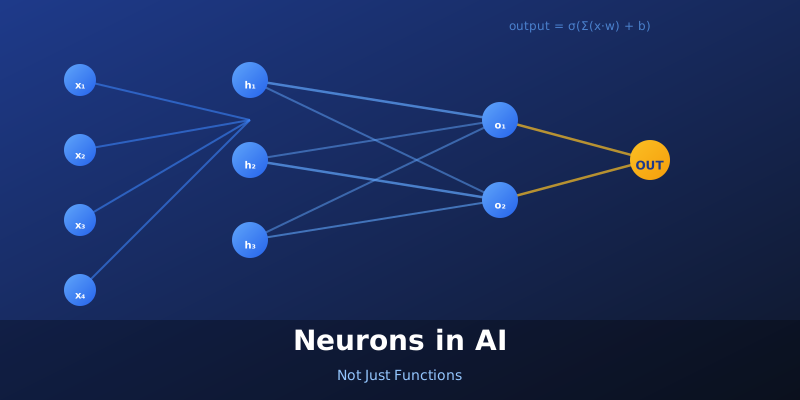
Here’s what happens inside a single artificial neuron [1]:
- Inputs arrive from elsewhere (either the original data or outputs from previous neurons)
- Each input gets multiplied by a weight — a numerical value that determines how important that input is
- All the weighted inputs are summed together
- A bias gets added (a standalone adjustable number)
- The result passes through an activation function [3]
- Out comes a single output
So the neuron computes something like: output = activation_function(sum(inputs × weights) + bias).
How That’s Different From a Function
Let’s say you write a Python function:
def add_numbers(a, b):
    return a + b
This function always behaves the same way. Feed it 2 and 3, get 5. Feed it the same inputs forever, you always get the same output. The logic is fixed.
A neuron? Its behavior changes over time [2]. The weights and bias aren’t constants you hardcode. They’re parameters that get adjusted during training. The neuron starts with random weights, receives feedback on whether its outputs were right or wrong, and then adjusts those weights to do better next time. Your hardcoded function can’t do that.
Another difference: a regular function is deterministic and transparent. I can read the code and see exactly what it does. A neuron’s calculation is visible, sure, but why it made those weight adjustments is less obvious. When a neural network gets trained on thousands of examples, figuring out why a particular neuron ended up with weight 0.75 for input A instead of 0.73 becomes genuinely hard [2].
Weights and Bias — The Learnable Parts
This is the heart of why neurons are different from functions. Those weights and bias? They’re not hand-written. They’re learned.
During training, an algorithm (typically something called backpropagation) looks at the outputs the neuron produced, compares them to what it should have produced, and nudges the weights and bias to reduce that error. Do this millions of times across billions of parameters, and suddenly the network has learned patterns in the data that humans never explicitly programmed [4].
The weight on an input controls how much that input influences the neuron’s output. A high weight means “this input matters a lot.” A negative weight means “if this input is high, reduce the output.”
The bias is an offset. It’s a way for the neuron to shift its decision boundary even when all inputs are zero. Think of it as the neuron’s baseline tendency — does it lean toward outputting 1 or 0 before any data even arrives? [4][5]
The Activation Function — Why Neurons Need Non-linearity
Here’s a detail that surprises some beginners: if neurons just summed weighted inputs without the activation function, stacking them wouldn’t add power. You’d just end up with another linear function.
(w1*x1 + b) → (w2*(w1*x1 + b) + b2) → still just a line
The activation function breaks this. It’s a non-linear function applied to the weighted sum. Common choices:
- ReLU (Rectified Linear Unit): If input is negative, output 0. Otherwise, output the input. Simple but powerful.
- Sigmoid: Squashes output to between 0 and 1. Good for probabilities.
- Tanh: Similar to sigmoid but outputs between -1 and 1.
The activation function is what lets neurons combine in interesting ways to model complex relationships [3].
One Neuron Isn’t Useful. Many Are.
A single neuron? Not very powerful. It can learn a simple linear boundary between two classes of data. But chain hundreds or thousands of them together — arrange them in layers where each layer’s output feeds into the next — and suddenly you can learn incredibly complex patterns [1].
That layered arrangement is the neural network. The first layer processes raw inputs. Hidden layers in the middle refine the signal. The output layer gives you your final answer. Each connection between neurons has its own weight, and during training, all of those get tweaked simultaneously [3].
So Why Call It a Neuron?
The name comes from a loose biological inspiration. Real neurons in your brain receive signals from neighboring neurons, sum those signals, and fire or don’t fire based on whether the sum exceeds a threshold. Artificial neurons do something mathematically similar — they sum weighted inputs, add a bias, apply a non-linear function.
The analogy breaks down fast if you push it too far. Real neurons are vastly more complex, with different types, time-dependent dynamics, and chemical processes we don’t fully understand. But for the purposes of building AI models, the analogy is close enough to be useful [1][2].
The Practical Takeaway
When you’re building or using a neural network, don’t think of neurons as miniature programs. Think of them as adjustable mathematical gates. Each one is simple. Dumb, even, on its own. The intelligence emerges from having many of them, learning from data, and their weights converging to useful values.
A function is a fixed behavior written once and run forever. A neuron is a learnable component that adapts based on data. That’s the core difference, and it’s why neural networks can do things traditional programmed functions can’t.
End