
Every January some report says “this is the year AI changes everything,” and every year I roll my eyes a little. But sitting here in mid-2026, I genuinely can’t roll my eyes anymore. Browsers are agents now. Chips are shipping “physical AI” models. Robots are clocking actual factory shifts. Some of this is real progress, some of it is still marketing dressed up as a product launch — and honestly, figuring out which is which is half the fun.
I’ve spent the last few weeks going through what’s actually shipped versus what’s still vaporware, and I want to walk through it the way I’d explain it to a friend over chai — what’s real, what’s hype, and what you should actually care about.
AI Agents Finally Started Doing Real Work (Not Just Demos)
For the last couple of years, “AI agent” mostly meant a chatbot with extra steps. That’s changed. Gartner predicts that 40% of enterprise applications will embed AI agents by the end of 2026, up from less than 5% in 2025 [1]. That’s not a small jump — that’s basically every SaaS tool you use at work quietly getting an “agent” tab.
What’s more interesting to me is the shift from single do-everything assistants to teams of specialized agents working together. Gartner reported a 1,445% surge in multi-agent system inquiries between Q1 2024 and Q2 2025 [2]. Think of it like hiring — instead of one generalist employee, companies are now spinning up a “team”: one agent that plans, one that writes code, one that checks the output, one that files the report. They argue with each other, basically, until the task is done.
Google Cloud’s own research backs this up — agentic AI is expected to reshape sales, software development, finance, healthcare, logistics, cybersecurity, and support, moving from “pilot project” to “thing the business actually depends on” [3]. I’ve started wiring up small agent workflows for repetitive parts of my own job — log triage, PR summaries, that kind of thing — and the honest truth is: when it works, it’s genuinely useful. When it doesn’t, it fails in weirdly confident ways. Trust it, but watch it.
The Frontier Model Pile-Up: GPT-5.5, Gemini 3.1 Pro, Claude Opus 4.8, Grok 4.3
If you feel like you can’t keep up with model names anymore — you’re not imagining it. By June 2026, the model everyone was talking about a few months ago has already been replaced. GPT-5.1 became GPT-5.5, Claude Opus 4.5 became Opus 4.8, and Gemini 3 turned into Gemini 3.1 Pro [4].
Here’s roughly how the big four stack up right now, based on the latest benchmark roundups [4][5]:
| Model | Maker | Best known for | Notable trait |
|---|---|---|---|
| Claude Opus 4.8 | Anthropic | Coding, leads overall intelligence index | Edges out GPT-5.5 on coding tasks |
| GPT-5.5 | OpenAI | Creative writing, coding | Neck-and-neck with Opus on code |
| Gemini 3.1 Pro | Reasoning, data analysis | Strong multimodal + deep Chrome integration | |
| Grok 4.3 | xAI | Agentic/tool-use tasks | Cheapest of the four, strong on tools |
Claude Opus 4.8 currently tops the Artificial Analysis Intelligence Index at 61.4, just ahead of GPT-5.5 at 60.2 [4]. But honestly? These gaps are small enough that the “best” model is really the one that fits your workflow and budget, not whichever one is technically winning a leaderboard this week. By the time you read this, there’s a decent chance one of these numbers has already shifted again.
Your Browser Is Quietly Becoming an Agent
This is the one that snuck up on me. Three major players are now turning the humble web browser into something that acts on your behalf: OpenAI’s ChatGPT Atlas, Perplexity’s Comet, and Google’s Gemini in Chrome [6][7].
- ChatGPT Atlas — launched as a dedicated browser with “Agent Mode,” which can execute multi-step tasks autonomously, plus a memory feature so you can ask “find all the job postings I was looking at last week” and actually get an answer [6].
- Gemini in Chrome (Auto Browse) — rolled out to all Chrome users in January 2026, meaning roughly 3 billion Chrome users now technically have access to autonomous browsing [7].
- Perplexity Comet — already crossed a million users, expanded to enterprise customers in March 2026, and can be silently deployed across company devices via MDM [7].
Atlas reportedly wins on memory depth and agent autonomy, Comet wins on speed and price for quick lookups [7]. My honest take: this is the part of 2026 tech that’s going to mess with website analytics and SEO the most. If an AI is “browsing” on your behalf and summarizing pages instead of you clicking through, a whole industry built around page views just got a rug pull. Nobody fully knows how this settles yet.
Nvidia’s Vera Rubin: The Chips Powering All of This
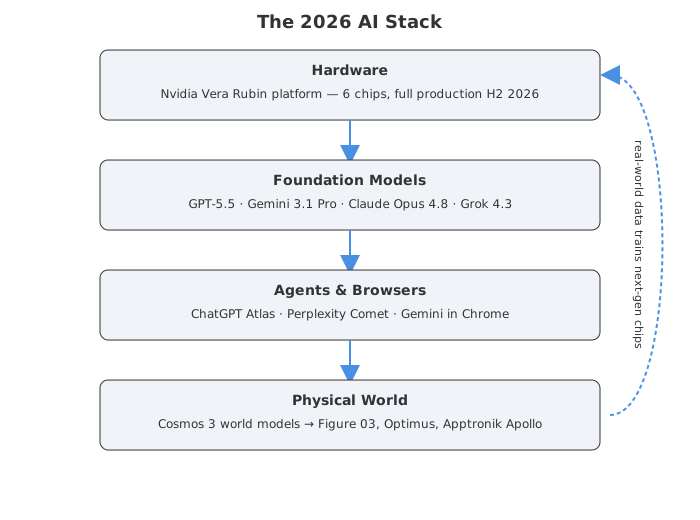
None of the above happens without silicon, and Nvidia spent CES 2026 making sure everyone knew exactly whose silicon. The Vera Rubin platform is now in full production — six new chips designed to deliver up to a 10x reduction in inference token cost compared to the previous Blackwell generation [8].
The setup combines one Vera CPU with two Rubin GPUs in a single processor, plus four supporting chips: the NVLink 6 Switch, ConnectX-9 SuperNIC, BlueField-4 DPU, and Spectrum-6 Ethernet Switch [9]. In practical terms, Nvidia says an NVL72 rack can train models using a quarter of the GPUs the old Blackwell setup needed, while delivering 10x higher inference throughput per watt at a tenth of the cost per token [9].
AWS, Google Cloud, Microsoft, and Oracle Cloud are among the first to deploy Rubin-based instances later in 2026 [10]. If that all sounds abstract, here’s the translation: the AI services you use should get noticeably cheaper to run by next year — whether that savings gets passed to you or just pocketed as margin is, as always, a different question entirely.
Physical AI: Humanoid Robots Leave the Lab for the Factory Floor
Who’s actually winning?
This is the category where 2026 stopped being theoretical. Tesla’s Optimus, Figure’s Figure 03, and Apptronik’s Apollo are all now shipping units to industrial pilot customers — the first time three humanoid robot programs have hit early production simultaneously [10].
| Robot | Maker | Real-world traction | Target price |
|---|---|---|---|
| Figure 03 | Figure AI | Helped build 30,000+ BMW X3s at Plant Spartanburg; expanding to Plant Leipzig | Not publicly listed |
| Optimus (Gen 3) | Tesla | Zero announced external customers as of April 2026 | ~$20,000–$30,000 [11] |
| Apollo | Apptronik | Shipping to industrial pilot customers Q2 2026 | Not publicly listed |
According to one tracker, Figure currently scores 78.9 out of 100 on overall readiness versus Tesla’s 45.1, with the biggest gap in real-world deployment (79 vs 32) [10]. That’s a pretty blunt scoreboard for a company as hyped as Tesla — and it lines up with what I’d expect. Building a humanoid robot is “easy” compared to getting a factory to actually trust it on the line for ten months straight. Figure did that. Tesla, as of this writing, hasn’t shown it publicly yet.
The world models behind the robots
What’s quietly enabling all of this is Nvidia’s Cosmos 3, an open “world model” trained on 20 trillion tokens of multimodal data — nearly a billion images, 400 million videos, plus audio and action data from humans and robots [12]. The idea is that robots can practice in a simulated world before ever touching a real part, which is exactly the kind of unglamorous infrastructure work that makes the flashy robot demos possible in the first place [13].
Smart Glasses: The Wearable War Everyone Saw Coming
Meta has had the smart glasses market basically to itself — it sold over 7 million Ray-Ban smart glasses in 2025 and controls roughly 82% of the global market [14]. Its $800 Ray-Ban Display, with an actual screen built into the lens, has been sitting there unanswered for months.
Apple’s response is reportedly coming. Bloomberg’s Mark Gurman says Apple is testing four distinct frame designs for its first smart glasses, codenamed N50, using acetate for a “higher-end” feel compared to the typical plastic frames [15]. The plan, allegedly, is to unveil them in September or October 2026 — deliberately timed to disrupt Meta’s momentum right before the holiday shopping season [14].
Here’s the catch though: Apple’s first-gen glasses reportedly won’t have a display or any augmented reality features at all. They’ll pair with an iPhone over Bluetooth for processing, much like the current Meta Ray-Bans without the Display model [15]. So depending on who you ask, Apple is either playing it safe with a “good enough” first version, or it’s already a generation behind on the feature that actually matters. I’d bet on the former — Apple rarely ships the flashy version first, it ships the “boring but reliable” version and lets the ecosystem catch up.
Foldable Phones Got a Third Fold — And a Reality Check
Tri-fold phones had their big “arrived” moment at CES 2026, and then almost immediately had a humbling moment too.
| Device | Maker | Unfolded display | Status (mid-2026) |
|---|---|---|---|
| Galaxy Z TriFold | Samsung | 10-inch — largest screen ever on a Galaxy phone | Sales paused in Korea & US after ~3 months [16][17] |
| Mate XT | Huawei | 6.4" phone expands to 10.2" 3K display via Z-fold | Still on sale, early mover [18] |
| Tri-fold (unannounced) | Xiaomi | TBD | In development [18] |
Samsung’s Galaxy Z TriFold launched in Korea on December 12, 2025, and the US on January 30, 2026 — folded, it’s 12.9mm thick and weighs about 10.9 ounces [16]. Then, in March 2026, Samsung quietly announced it was ending Z TriFold sales in both Korea and the US after just three months, while reportedly working on a second-gen version for 2027 [17].
That’s a pretty fast reversal for a flagship device. The problem, according to reviewers, wasn’t really the hardware — it’s that the software hasn’t caught up. A lot of apps just do an “equal proportion zoom” on the bigger screen instead of actually using the extra space, so you’re left holding a 10-inch tablet that behaves like a stretched phone [18]. This is the classic foldable problem all over again — manufacturers keep solving the hinge before they solve the experience.
Quantum Computing Enters Its “Fault-Tolerant Era”
Quantum computing has spent years being “five years away,” and 2026 — officially designated the International Year of Quantum Science and Technology by the UN — is the year a few of those five-year promises actually started landing [19].
- Fault tolerance breakthroughs: Work out of Mikhail Lukin’s lab at Harvard has reportedly pushed quantum error-correction timelines forward faster than expected, attracting billions in private investment [19].
- Cryoelectronics for ion traps: Researchers at Fermilab and MIT’s Lincoln Laboratory successfully trapped and manipulated ions using in-vacuum cryoelectronics — a real step toward large-scale ion-trap quantum systems [21].
- Room-temperature quantum devices: Stanford researchers built a device that uses twisted light to entangle photons and electrons without needing extreme cooling, potentially opening the door to smaller, cheaper quantum systems [20].
The industry framing is that 2026 marks the point where adding more qubits actually starts reducing error rates instead of just adding more noise — which, if you’ve followed quantum computing skepticism over the years, is kind of the whole ballgame [19]. I’d still file this under “exciting, but not in your pocket anytime soon” — but the gap between “lab curiosity” and “engineering roadmap” genuinely seems to have narrowed this year.
The Not-So-Fun Part: AI’s Massive Power Bill
Here’s the thing nobody puts on the conference keynote slide: all of this — the agents, the models, the robots — needs an absurd amount of electricity. Data center electricity consumption could approach 1,050 terawatt-hours by 2026, which would make data centers the fifth-largest electricity consumer in the world, between Japan and Russia [22].
As of 2024, most of that power (40%) came from natural gas, with nuclear at around 20% [22]. But that’s shifting fast. Meta’s deals with Vistra, TerraPower, Oklo, and Constellation Energy make it one of the largest corporate buyers of nuclear power in American history, supporting up to 6.6 GW of clean energy by 2035 [23]. Microsoft is reportedly getting Constellation to restart the Three Mile Island plant by 2027, and AWS signed a 17-year, 1.92 GW power deal tied to the Susquehanna nuclear plant [22].
This is the part of the AI story that I think gets the least attention but matters the most long-term. Every “AI just got 10x cheaper” headline is sitting on top of an energy infrastructure story that’s playing out in the background, mostly in places you’ll never hear about unless a nuclear plant near you suddenly gets a new corporate tenant.
Brain-Computer Interfaces Quietly Get Real
Neuralink had a big claim this year: Elon Musk says the company will start high-volume production of brain-computer interface devices in 2026, moving to an almost entirely automated surgical procedure where the device threads go through the dura without needing to remove it [24].
As of the latest count, three people with paralysis have received implants, with the company having implanted up to 12 patients total by last count [25]. The first recipient, Noland Arbaugh, has used his implant to play video games and online chess [25]. Neuralink’s Blindsight implant — aimed at restoring vision for people who are completely blind — is scheduled for its first patient trial in 2026 [25], and the company is also building a surgical robot designed to reach any part of the brain with high precision [25].
The honest caveat here: even optimistic reporting puts realistic commercial availability at 2028-2030 [25]. So “ramping up production” in 2026 mostly means scaling clinical trials, not shipping a consumer product. Still — going from “1 patient” to “12 patients and an automated surgical robot” in about 18 months is a real pace of progress, whatever you think of the company behind it.
CES 2026 Grab Bag: The Smaller Stuff Worth Knowing About
Not everything from CES 2026 needs its own section, but a few things are worth filing away:
- Samsung Micro RGB TVs are going mainstream — the 2026 lineup spans 55 to 115 inches, bringing a backlight tech previously reserved for ultra-premium sets down to more normal price tiers [26].
- AMD’s Ryzen 7 9850X3D bumps clock speeds by 400 MHz over the 9800X3D — a modest but welcome bump if you’re due for a gaming PC upgrade [27].
- Samsung and LG both showed new RGB-stripe OLED panels, including a 34-inch, 360 Hz QD-OLED from Samsung — good news if competitive gaming is your thing [27].
- Amazon’s Ember Artline TVs are designed to look like framed pictures on your wall, running Fire TV with Alexa built in, in 55- and 65-inch sizes [28].
- Caterpillar’s AI Assistant — yes, the heavy machinery company — now helps customers buy, maintain, and operate equipment, which is a good reminder that “AI everywhere” isn’t just a phone and laptop thing anymore [28].
Honestly, half of CES every year is this kind of stuff — incremental, useful, completely unglamorous. But it’s also the stuff that actually shows up in your life faster than humanoid robots or smart glasses ever will.
If there’s one thread running through all of this, it’s that 2026 is the year the gap between “AI demo” and “AI in production” started closing — in your browser, in a BMW factory, in a hospital implanting brain chips, and in a power plant getting a second life because a data center needs the electricity. Some of it’ll age badly (I’m looking at you, Galaxy Z TriFold). Most of it won’t wait around for you to catch up.
Sources
- 8 Ways AI Agents Are Evolving in 2026 - Salesforce
- 7 Agentic AI Trends to Watch in 2026 - MachineLearningMastery.com
- AI agent trends 2026 report | Google Cloud
- Gpt-5.1 vs Gemini 3 Pro vs Claude Opus 4.5 Breakdown Report - Vellum
- Best AI Models 2026: GPT-5 vs Claude 4.5 Opus vs Gemini 3 Pro (Complete Comparison)
- Introducing ChatGPT Atlas | OpenAI
- The Agentic Browser Landscape in 2026: A Complete Guide | No Hacks
- NVIDIA Vera Rubin Opens Agentic AI Frontier | NVIDIA Newsroom
- Inside the NVIDIA Vera Rubin Platform: Six New Chips, One AI Supercomputer | NVIDIA Technical Blog
- Figure 03 vs Tesla Optimus Comparison Tracker (2026) – New Market Pitch
- Tesla robot price in 2026: Everything you need to know about Optimus - Standard Bots
- NVIDIA Launches Cosmos 3, the Open Frontier Foundation Model for Physical AI | NVIDIA Newsroom
- Nvidia’s Cosmos 3 open AI world model helps robots, autonomous vehicles - Axios
- Apple May Unveil Smart Glasses in Late 2026 - and Meta Has Every Reason to Worry - Gadget Review
- Apple reportedly testing out four different styles for its smart glasses that will rival Meta Ray-Bans - Engadget
- Samsung Galaxy Z TriFold hands-on: Flexing is believing at CES 2026 - Engadget
- Samsung Galaxy Z TriFold - Wikipedia
- 2026 Tri-Fold Smartphone Guide: Comparing Huawei Mate XT and Samsung Galaxy Z TriFold - Vertu
- Harvard Researchers: Quantum Computing Advancing Faster Than Expected - The Quantum Insider
- Stanford quantum computing breakthrough uses twisted light to work without extreme cooling | ScienceDaily
- DOE national quantum research centers reach breakthrough towards building scalable quantum computers - Fermilab
- Data Centres, Artificial Intelligence and Cryptocurrencies Eye Advanced Nuclear to Meet Growing Power Needs | IAEA
- Meta Announces Nuclear Energy Projects, Unlocking Up to 6.6 GW to Power American Leadership in AI Innovation
- Neuralink to kick-start ‘high-volume production’ of brain-computer interface devices, Elon Musk says - Fierce Biotech
- Neuralink’s next robot could reach any part of the brain - YourStory
- CES 2026: The Future is Here
- CES 2026: all the upcoming releases and announcements a PC gamer should know about | PC Gamer
- What Not To Miss at CES® 2026