
The iPhone vs Android debate is one of tech’s most enduring rivalries — and in 2026, it remains genuinely competitive. Yet despite Android’s dramatic improvements in update longevity and camera hardware, the iPhone continues to hold meaningful, measurable advantages across several critical dimensions. Whether you’re a first-time buyer or considering a switch, here are six areas where iPhone consistently comes out ahead.
Security and Privacy: iPhone’s Most Durable Lead
When it comes to protecting your data, iPhone holds a structural edge that goes beyond marketing. Apple’s App Tracking Transparency (ATT) framework, introduced in iOS 14.5 and refined since, blocks third-party ad trackers by default — Android users must manually configure similar protections [1]. A 2025 Privacy International report ranked iOS ahead of stock Android on twelve of fifteen privacy criteria examined, noting that while the gap has narrowed since 2020, it persists on default settings, data retention policies, and cross-service data sharing [2].
On the security front, the architecture differs fundamentally:
- iOS patches roll out to all supported iPhones simultaneously, the moment a vulnerability is discovered [3]
- Android patches must filter through device manufacturers and carriers first, creating weeks or months of exposure for non-Pixel devices [3]
- Apple’s App Store enforces a rigorous manual review process, significantly reducing the risk of malware reaching users [4]
- Features like Face ID, Secure Enclave hardware, and end-to-end iMessage encryption are built into every iPhone [1]
Google’s Pixel series has narrowed the security gap considerably with its Titan M2 chip and proactive scam-call filtering [2], but iPhone’s privacy defaults remain the gold standard for users who don’t want to configure their phone like a sysadmin.
Software Updates That Actually Reach You
For years, Android’s fragmented update delivery was its Achilles’ heel. While things have improved — Google Pixel 9 and Samsung Galaxy S25 now both promise seven years of OS and security updates [5] — the iPhone’s update model still holds key practical advantages.
Apple delivers iOS updates to all supported devices within 24 hours of release, regardless of carrier, region, or manufacturer [6]. There is no middleman. An iPhone purchased in 2019 running iOS 18 receives the same security patch, on the same day, as an iPhone 16 Pro [1].
| Platform | Update Years (Flagship) | Simultaneous Rollout? | Budget Device Support |
|---|---|---|---|
| Apple iPhone | 6–7 years | ✅ Yes | ✅ Yes (same schedule) |
| Google Pixel | 7 years | ✅ Yes | ❌ Limited |
| Samsung Galaxy | 7 years (S-series) | ❌ Staggered | ❌ 2–3 years |
| Other Android OEMs | 1–3 years | ❌ Staggered | ❌ 1–2 years |
The real-world implication: a mid-range iPhone purchased today will remain secure and feature-current for years longer than its Android counterpart at the same price point [5].
The Apple Ecosystem: A Network Effect No Android Brand Can Match
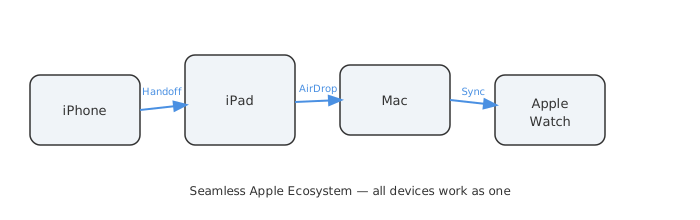
Apple’s greatest long-term moat isn’t any single device — it’s the seamless integration across all its hardware. iPhone, iPad, Mac, Apple Watch, AirPods, and HomePod all communicate fluently through features that simply work out of the box [6]:
- AirDrop: Instant, encrypted file transfers to any nearby Apple device — no app or account required
- Handoff: Start a document, email, or call on iPhone and pick it up on your Mac without skipping a beat
- Universal Clipboard: Copy text on your iPhone, paste it on your MacBook
- Continuity Camera: Use your iPhone as a high-quality Mac webcam wirelessly
- iMessage / FaceTime: End-to-end encrypted messaging and video calls that work natively across all Apple devices
Samsung has built a credible ecosystem with Galaxy devices, but it doesn’t extend across other Android brands [6]. If you own a OnePlus phone and a Lenovo laptop, you get none of these integrations. Apple’s ecosystem works because Apple controls both the hardware and software stack — a constraint that also explains most of iPhone’s other advantages.
Superior Resale Value: iPhones Hold Their Worth
If total cost of ownership matters to you, the iPhone’s resale value advantage is striking. On average, iPhones retain 60–70% of their original value after two full years of use [7]. The picture diverges sharply over longer timeframes:
- After four years, iPhones still retain roughly 52.5% of original value [7]
- Flagship Android phones drop to approximately 21.1% over the same period [7]
- Budget Android phones retain as little as 12.2% [7]
The iPhone 15 and 16 Pro models have been shown to keep over 70% of value after just one year of ownership [8]. This means that, when you factor in what you’ll recoup at trade-in or resale, the real cost gap between a premium iPhone and a premium Android device is considerably smaller than the sticker price suggests.
Consistent Performance and Class-Leading Video
Apple designs both the iPhone’s chip and its operating system, a level of vertical integration no Android OEM can fully replicate. The result is performance that stays smooth across years of use. In 2026 benchmark testing, the iPhone 17 achieves an average gaming frame rate of 130.97 FPS compared to 80.58 FPS on the Pixel 10 [1] — a gap that reflects Apple Silicon’s lead in mobile CPU and GPU architecture.
For video creators specifically, iPhone Pro models remain the industry benchmark [9]:
- ProRes recording for professional post-production workflows
- Log video capture for flexible color grading in cinema-grade software
- Cinematic mode for automatic rack-focus shallow depth-of-field video
- Action mode for heavily stabilized footage without an external gimbal
ProRes footage shot on iPhone Pro appears regularly in commercial productions and short films [9] — a creative credential no current Android device can claim at scale.
App Store Quality and Developer Priority
Developers consistently prioritize iOS when launching new apps and features [4]. The reasons are partly economic (iOS users spend more in apps) and partly logistical — Apple’s unified hardware makes it far easier to test and optimize an app than Android’s sprawling device fragmentation [4].
The practical result for users:
- New apps typically launch on iOS first, often months before Android versions arrive
- Apple’s strict App Store review process filters out low-quality, insecure, or deceptive apps before they reach users [4]
- Apple’s TestFlight beta platform gives users early access to polished pre-release software in a controlled environment
- Tools like Xcode and SwiftUI give developers a tightly integrated, consistent development environment that maps cleanly to every iPhone screen size and sensor [4]
This developer-first dynamic means iPhone users consistently get access to higher-quality, more stable app experiences sooner.
The Bottom Line
Android in 2026 is genuinely excellent — especially Pixel and Samsung Galaxy flagships. But iPhone’s advantages in privacy defaults, simultaneous software updates, ecosystem cohesion, resale value, sustained performance, and developer mindshare are measurable, not just marketing. For users who want a device that works deeply with other Apple hardware, stays secure without manual configuration, and holds its value over time, iPhone remains the stronger long-term investment.
Sources
- iPhone vs Android 2026: Privacy, Performance, and Costs
- iPhone vs Android Privacy and Security in 2026 — Secrets of Privacy
- Android vs. iOS: Security Comparison 2026 — NordVPN
- Android vs. iOS App Development: Which is Better in 2026? — Shakuro
- Android vs iOS Security in 2026: Is iPhone Still Safer? — MacObserver
- Android vs iPhone Ecosystem in 2026 Compared — Swapper
- The 2026 Resale Value Report: Which Smartphones Hold Their Worth Best? — iGenius Phone Repair
- Which Cellphones Hold Their Resale Value the Longest in 2026? — ecoATM
- Why the iPhone is Better Than Android in 2026 — 73inc