The frontend ecosystem shifts every year, but 2025-2026 felt structurally different. It wasn’t just new libraries — the underlying mental models changed. How we hydrate, bundle, structure components, and handle reactivity has moved in ways that actually affect how apps perform and how long they take to build. Here’s what’s worth paying attention to.
The Framework Landscape Is Fragmenting (In a Good Way)
React still dominates with roughly 45% adoption [1], but calling it the default answer is getting harder to justify for every project type. Three challengers are serious now.
Svelte 5 shipped its biggest overhaul yet: Runes. These are explicit reactive primitives — $state, $derived, $effect — that replace Svelte 4’s implicit $: label syntax [3]. The shift is significant. Runes are proper signal-based reactivity that works anywhere — inside components, in stores, in utility functions — not just at the top level of a .svelte file. Benchmarks from the Krausest js-framework test show Svelte 5 running 20–40% faster than React 19 even with the React Compiler enabled, and memory usage sitting 50% lower [4].
React 19 is not sitting still either. The React Compiler (v1.0, shipped October 2025) auto-memoizes components at build time, which means the useMemo / useCallback / React.memo ritual is no longer your problem [3]. Server Components moved from experimental to stable [2], and Actions API cleaned up the async mutation story significantly. React’s disadvantage is still bundle weight — the trade-off is its enormous talent pool and ecosystem.
Vue 3.6 closed most of the DX gap with React while staying tighter on bundle size. The framework convergence article at byteiota.com frames it well: “all three are chasing the same goals — less boilerplate, faster rendering, better TypeScript integration” [12].
SolidJS deserves a mention too. It doesn’t have the adoption numbers but its fine-grained reactivity model (true signals, no VDOM) continues to influence how React and Svelte are evolving their own reactivity APIs [10].
Server-First Is the New Default
The biggest architectural shift is the move away from client-heavy SPAs toward server-first rendering with selective client hydration [13]. Two patterns are leading this.
Island Architecture
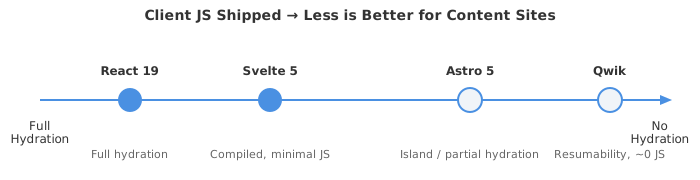
Astro 5 is the clearest implementation. The idea: ship static HTML, then hydrate only the interactive components — “islands” — with JavaScript [5]. Astro’s client:* directive set lets you mix React, Svelte, Vue, Solid, and Lit components on the same page, each hydrated independently. In late 2024, Astro added Server Islands — dynamic server-rendered fragments that execute separately from the main page response, so one slow API call doesn’t block the entire page [5].
For content-heavy sites, this is the architecture worth defaulting to. You’re not shipping a 200KB React runtime to render a blog post.
Resumability
Qwik takes an even more aggressive stance. Resumability rejects hydration entirely [6]. Instead of re-running components on the client to attach event listeners, Qwik serializes listener references into the HTML (on:click="./chunk.js#handler") and uses a single global listener to load chunks on demand [6]. The page “resumes” from the server’s serialized state — no framework code executes until the user actually interacts with something. In theory, Time to Interactive approaches zero.
The Astro + Qwik integration lets you get both patterns together: static by default, resumable islands for interactivity [6].
Build Tools: Webpack Is Dead, Long Live Rust
Three serious bundlers are left standing [7]:
| Tool | Best For | Cold Start (large app) | Notes |
|---|---|---|---|
| Vite 6 | New projects | ~2s | Powered by Rolldown (Rust) replacing esbuild [8] |
| Rspack | Webpack migrations | ~1.4s | Built by ByteDance, webpack-compatible config [8] |
| Turbopack | Next.js shops | Fastest HMR | Default in Next.js 16, no other framework support [7] |
Vite 6.0 switched its production build engine to Rolldown, a Rust-based bundler that replaces Rollup. esbuild is being phased out for production by end of 2026 [8]. If you’re starting a new project, Vite is still the call. If you’re migrating a webpack codebase, Rspack is the least painful path — it accepts your existing webpack config and plugins.
Webpack itself? Still running in production at thousands of companies. But no one is starting new projects on it in 2026.
UI Libraries: shadcn/ui Changed the Model
The interesting shift here isn’t a new library winning — it’s a change in how developers think about component libraries.
shadcn/ui popularized a different model: you own the code [11]. Instead of installing a package and getting opaque components you can’t inspect or customize, shadcn/ui lets you copy components directly into your project. Full control over styling, markup, behaviour. It’s built on Radix UI primitives with Tailwind, and has become the default starting point for new React apps in 2026 [11].
The established players haven’t gone anywhere:
- MUI — 97,000+ GitHub stars, 4.5M weekly downloads, enterprise default [11]
- HeroUI (formerly NextUI) — rebranded in early 2025, growing fast [11]
- Chakra UI — 40,000+ stars, 700K downloads/week, still widely used [11]
Tailwind CSS continues to dominate utility-first styling. There’s not much debate left there.
Design Patterns That Actually Stuck
A few patterns crossed from “interesting idea” to “production standard” this cycle [9]:
- Signals/Fine-grained reactivity — Svelte 5 Runes, SolidJS signals, and now TC39 has a Signals proposal in progress. The VDOM may not be the long-term answer.
- CSS Container Queries — components that adapt to their parent container size, not the viewport. Makes component libraries genuinely reusable without media query hacks [13].
- Feature-Sliced Design (FSD) — a folder structure convention that organizes code by feature, then layer (pages → widgets → features → entities → shared). Growing adoption in large React codebases because flat
components/directories become unmaintainable fast [10]. - Atomic Design — breaks interfaces into atoms, molecules, and organisms. Not new, but container queries and Server Components have given it a second life [9].
TypeScript and AI-Assisted Development
TypeScript is no longer optional in professional frontend work [13]. It’s the default for every major framework’s CLI. React 19, Angular 21, Vue 3.6, Svelte 5 — all ship with first-class TypeScript support out of the box. The era of debating whether to add TypeScript ended quietly somewhere around 2024.
AI tooling (GitHub Copilot, Cursor, etc.) has genuinely changed the workflow for boilerplate. Design-to-code tools using AI can reduce concept-to-implementation time significantly for standard UI patterns [9]. But — and this is worth saying clearly — AI-generated code still needs a developer who understands what’s being generated. The mental models described in this article are what separate a developer who uses AI well from one who just pastes whatever the LLM outputs.
The React Compiler is its own kind of AI-adjacent automation: it analyses your code statically and inserts memoization where needed, removing a whole class of performance bugs without you doing anything [3]. That’s genuinely useful.
WebAssembly is maturing too — computationally heavy tasks like video editing, image processing, and 3D rendering now run directly in the browser without native apps [2]. Still niche, but the gap between “web app” and “native app” is getting harder to see.
End
Sources
- Best Frontend Frameworks 2026: Every Major JavaScript Framework You Need to Know
- 5 Frontend Frameworks That Will Dominate 2026 (Performance + AI)
- Svelte 5 Runes vs. React 19 Hooks: Which Reactivity Model Scales Better?
- React 19 Compiler vs Svelte 5: Latency Benchmark Results
- Islands Architecture — Astro Docs
- Astro + Qwik: Houston, we have Resumability!
- Vite vs Turbopack vs Rspack Benchmark [2026 Compared]
- Vite vs Rspack vs Turbopack: 2026 Frontend Bundler Comparison
- Frontend Trends and Design Patterns to Watch in 2026
- 5 Frontend Trends That Will Dominate 2026 — Feature-Sliced Design
- 5 Best React UI Libraries for 2026 (And When to Use Each)
- React 19 vs Vue 3.6 vs Svelte 5: 2026 Framework Convergence
- Frontend Development Trends 2026: What Modern Web Teams Should Focus on Now
- The 8 trends that will define web development in 2026