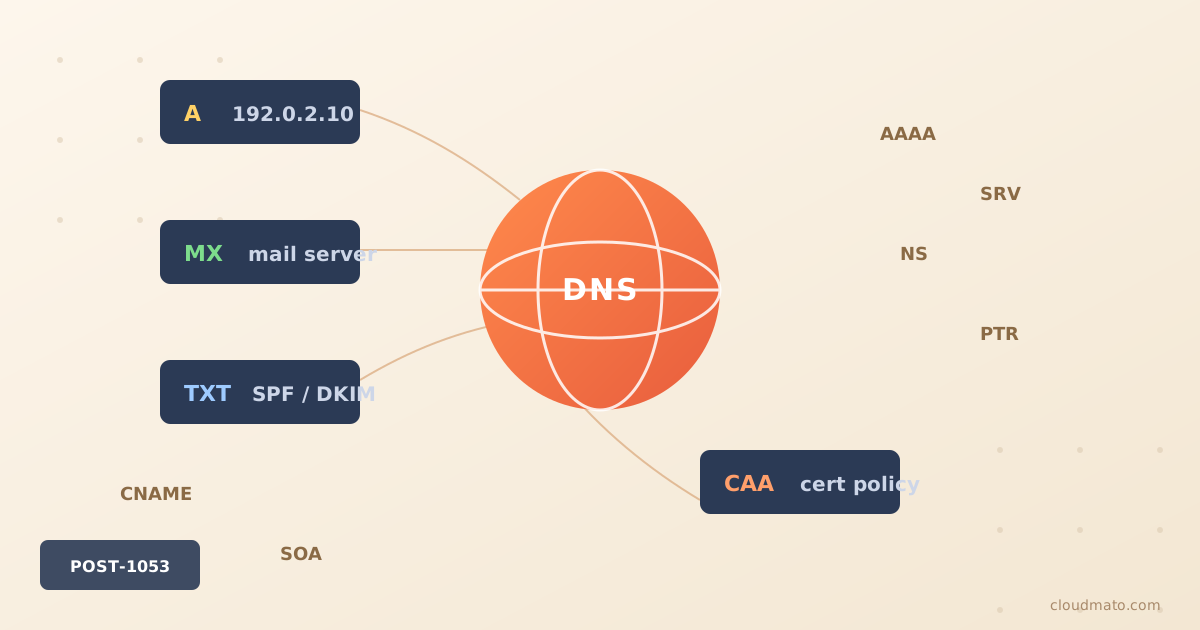
Open up any domain’s DNS settings and you’ll see a wall of cryptic codes — A, AAAA, MX, TXT, SRV, CAA, SVCB — and it genuinely looks like someone kept bolting random parts onto an old engine. Which, honestly, is exactly what happened. Every single one of these record types exists because the internet hit a wall that the existing records couldn’t get past, and once you see that history laid out, the whole mess actually starts to make sense.
Okay, So What Even Is a DNS Record?
Before the timeline, a quick refresher because it matters for everything that follows.
DNS is the internet’s phonebook [1]. Every entry in that phonebook is a “resource record,” and every record — no matter the type — follows the same basic shape that was nailed down back in November 1987 in RFC 1035 [2]:
example.com.    3600    IN    A    192.0.2.10
   |             |       |    |        |
  name          TTL    class type    data
Name, time-to-live, class (almost always IN for “internet” — nobody uses the others anymore), type, and then data whose format depends entirely on the type. That type field is the whole story here. It’s just a number. IANA keeps a registry of which number means what [16], and the data that follows gets interpreted completely differently depending on which number it is.
So when people ask “why are there so many DNS record types,” the honest answer is: because the type field was designed to be extended. It’s basically a plug-in system. Every time the internet needed a new kind of thing to look up — a mail server, an IPv6 address, a chat server, a certificate policy — someone wrote a proposal, the IETF turned it into an RFC, and IANA handed out a new type number. Forty-plus years of “the internet needed one more thing” is why your DNS panel looks like a control room.
The Original Crew (1983–1987)
DNS itself wasn’t always there. Before 1983, the entire internet (then ARPANET) relied on a single text file called HOSTS.TXT, maintained centrally by SRI International, that every machine downloaded to map names to addresses [4]. That worked fine when there were a few hundred hosts. It did not work when the network started growing exponentially.
Paul Mockapetris, working at USC’s Information Sciences Institute under Jon Postel, was asked to fix this. In 1983 he wrote RFC 882 and RFC 883, proposing a distributed, hierarchical database instead of one giant file [3]. Four years later those got revised and replaced by RFC 1034 and RFC 1035 in November 1987 [2], and that’s the document that defines the core record types still doing most of the heavy lifting today.
Here’s the original lineup and why each one needed to exist as its own type rather than just being a flag on another record:
| Record | What it does | Why it couldn’t just be folded into another type |
|---|---|---|
| A | Maps a hostname to an IPv4 address | This is the basic “phonebook” lookup — the whole reason DNS exists |
| NS | Says which servers are authoritative for a zone | Needed so resolvers know where to even ask the question |
| CNAME | Aliases one name to another name | Lets you point www at example.com without duplicating records |
| MX | Points to the mail server for a domain | Mail servers are often different machines than web servers — DNS needed a way to say “send mail here, not there” |
| SOA | Stores zone admin metadata (serial number, refresh/retry timers, admin contact) | Secondary DNS servers need this to know when to re-sync from the primary |
| PTR | Reverse lookup — IP address to hostname | A completely different direction of query than A records, so it needed its own structure |
| TXT | Free-form text | A catch-all “write whatever you want here” field — turned out to be wildly useful later (more on that below) |
| HINFO / WKS | Host hardware/OS info and well-known services | Mostly dead now — a good early example of a record type that just… didn’t survive |
That last row is actually instructive. Not every record type that gets defined sticks around. HINFO was meant to advertise what CPU and OS a host ran — which sounds like a privacy nightmare today, and indeed almost nobody publishes it anymore. DNS isn’t just additive; it occasionally prunes itself.
Hang On — Why Not Just Cram Everything Into One Record?
Fair question. Here’s why that doesn’t work, and it’s also the key to understanding the rest of this article.
Each record type defines its own wire format — the exact binary layout of the data that follows the type field. An MX record’s data is “a priority number plus a hostname.” A CAA record’s data is “a flag, a tag, and a value.” An SRV record’s data is “priority, weight, port, and target.” These shapes are fundamentally different, and a resolver needs to know the shape in advance to parse it correctly.
The clever part of the design is that unknown record types are just opaque blobs to old software. A 1990s DNS resolver that’s never heard of a CAA record will just shrug and pass it along unparsed instead of crashing. This is the same principle behind graceful degradation that’s kept DNS backward-compatible for over 40 years — old clients don’t choke on new types, they just ignore what they don’t understand [17].
But that forward-compatibility cuts both ways. A brand-new record type is technically “supported” the moment IANA assigns it a number, but it’s only useful once registrars, DNS hosting panels, validators, and applications all bother to add explicit support for it. We’ll see a great example of a record type that got defined and then mostly abandoned in favor of an older one — keep reading.
The Timeline: Every Time DNS Got a New Type, and Why
This is the part that actually answers “why are there so many” — each addition maps to a specific moment where the internet’s problems outgrew what existed.
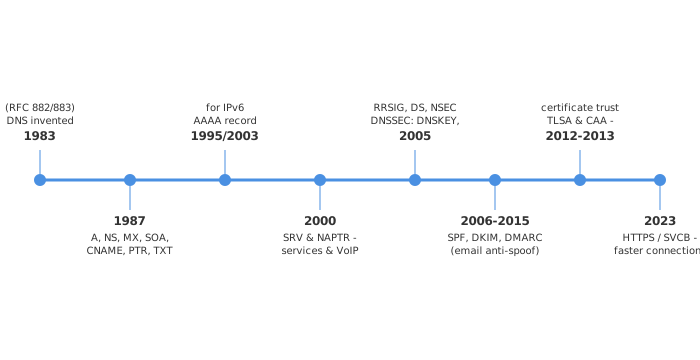
1995 (then 2003): AAAA — the internet was running out of addresses
IPv4 gives you about 4.3 billion addresses. That sounds like a lot until you remember every phone, laptop, smart bulb, and fridge wants one. By the mid-90s, engineers could already see the exhaustion coming, so IPv6 was designed with 128-bit addresses — vastly more room.
But RFC 1035’s A record was hardcoded for 32-bit IPv4 addresses. There was no way to stuff a 128-bit address into it. So in December 1995, AAAA (“quad-A,” because an IPv6 address is four times the size of an IPv4 one) was introduced in RFC 1886 [5]. It got revised in October 2003 as RFC 3596, which also moved reverse lookups from the awkward IP6.INT domain to IP6.ARPA [5]. If your website has ever had both an A and an AAAA record pointing at it, that’s your server saying “reachable over IPv4 and IPv6, take your pick.”
1996/2000: SRV — DNS grows up beyond web and mail
Here’s something that bugged protocol designers for years: MX records let you say “mail for this domain goes to that server, on a different port/host than the website.” Great. But what if you’re running a chat server, or a directory service, or literally any other protocol? Before SRV, every new protocol had to invent its own MX-style hack, or just hardcode a port and hope for the best.
SRV records generalized this. First proposed in RFC 2052 (1996) and standardized in RFC 2782 (February 2000), an SRV record specifies a priority, a weight (for load balancing), a port, and a target host [6]. Suddenly any service — XMPP chat, SIP voice calls, Microsoft Active Directory, even Minecraft servers — could say “here’s exactly which host and port to connect to for this specific service,” and admins could move things around or add failover servers without breaking client configs [6].
2000: NAPTR — when phone numbers needed DNS too
Around the same time, the telecom world was trying to merge with the internet — specifically, mapping traditional phone numbers (E.164 format) onto internet services via something called ENUM, and routing SIP (Session Initiation Protocol) calls.
NAPTR (Naming Authority Pointer) records, defined in RFC 2915 (2000), solved this by mapping a name to a regular-expression-based rewrite rule that produces a new domain name or URI [7]. Combined with SRV records, NAPTR let a single phone number resolve through DNS into “here’s the SIP server, here’s the port, here’s the protocol” [7]. It’s a niche record type for most people, but if you’ve ever made a VoIP call, NAPTR was quietly doing work behind the scenes.
2005: DNSSEC’s alphabet soup — DNSKEY, RRSIG, NSEC, DS
For its first ~20 years, DNS had zero authentication. A resolver asks a question, gets an answer, and just… trusts it. That’s a massive problem if someone can intercept or forge that answer — known as cache poisoning, where an attacker tricks a resolver into caching a fake IP address for a legitimate domain, silently redirecting traffic to a malicious server.
DNSSEC (DNS Security Extensions) fixes this with digital signatures, and it needed four new record types, formalized in RFC 4034 (March 2005), which obsoleted an earlier and clunkier 1999 attempt [8]:
- DNSKEY — holds the public key used to verify signatures for a zone
- RRSIG — the actual digital signature covering a set of records
- NSEC — proves a record doesn’t exist (so attackers can’t just claim “no such domain” undetected)
- DS — a hash that links a child zone’s key up to its parent zone, building a chain of trust
Adoption was slow for years — DNSSEC adds real complexity to zone management — but a wave of high-profile cache-poisoning research in the years following gave it a serious push, and DNSSEC is now considered table stakes for any domain that takes security seriously.
2006–2015: SPF, DKIM, DMARC — the war on email spoofing
If you’ve ever set up email for a custom domain, you’ve run into this trio, and honestly this is where DNS got really messy — because all three of these technically live inside the humble TXT record, the one that was originally just “write a free-text note here.”
- SPF (Sender Policy Framework) lists which mail servers are allowed to send email as your domain. It started in RFC 4408 (April 2006) as an IETF experiment [9], and — here’s the genuinely weird part — it originally got its own dedicated record type, type 99, literally called “SPF.” Nobody used it. DNS software vendors and admins just kept publishing SPF policy as TXT records because that’s what already worked everywhere. By RFC 7208 (April 2014), the IETF gave up and formally deprecated the dedicated SPF record type, mandating TXT-only [9][10]. It’s a rare case of a brand-new record type being defined, going almost completely unused, and then officially killed off less than a decade later [10].
- DKIM (DomainKeys Identified Mail), standardized as RFC 6376 in 2011 after about six years of development, adds a cryptographic signature to outgoing emails so receivers can verify the message wasn’t tampered with — published as a TXT record at
selector._domainkey.yourdomain.com. - DMARC (Domain-based Message Authentication, Reporting and Conformance) ties SPF and DKIM together and tells receiving servers what to do if a message fails both — quarantine it, reject it, or just report on it. It came out of an industry consortium (Google, Microsoft, Yahoo, PayPal, and others under DMARC.org) and was published as RFC 7489 in March 2015 [11], living at
_dmarc.yourdomain.com.
Why three separate things instead of one record type? Because they solve three different trust problems — who’s allowed to send (SPF), was this message altered (DKIM), and what should happen if checks fail, plus give me visibility (DMARC) — and they were built by different groups at different times, which is honestly very on-brand for how DNS evolves.
2023: HTTPS and SVCB — DNS gets smarter about connections
This is the newest entry, and it’s a good one to end on because it shows the pattern is still very much alive.
For most of the web’s history, visiting a site meant: DNS lookup for an A/AAAA record → open a TCP connection → do a TLS handshake → then send the HTTP request. Each step happens somewhat blindly — your browser doesn’t know in advance if the server supports HTTP/3, has alternate endpoints, or needs special TLS configuration.
SVCB (Service Binding) and HTTPS records, standardized together in RFC 9460 (November 2023), let a single DNS answer carry connection hints up front — preferred protocols like HTTP/3, alternate ports, IP hints, and parameters for encrypted ClientHello [the privacy-protecting TLS extension] [16]. The HTTPS record type is essentially a specialized version of SVCB just for web traffic, and it can do something CNAME never could: alias an apex domain (like example.com itself, not just www) to another name [16]. Browsers and CDNs are still rolling out support, but it’s the clearest sign yet that DNS keeps adapting as the web’s underlying protocols change.
The Cheat Sheet: Which Record Do You Actually Need?
If you’re staring at a DNS panel right now trying to figure out what to actually configure, here’s the practical mapping:
| What you’re trying to do | Record type(s) you need |
|---|---|
| Point your domain at a server (IPv4) | A |
| Point your domain at a server (IPv6) | AAAA |
Alias one hostname to another (e.g., www → example.com) | CNAME |
| Route incoming email to your mail provider | MX |
| Authorize servers to send mail as your domain | TXT (SPF policy) |
| Sign outgoing email cryptographically | TXT (DKIM key, at selector._domainkey) |
| Set a policy for failed email auth checks | TXT (DMARC, at _dmarc) |
| Prove domain ownership to Google/AWS/etc. | TXT (verification token) |
| Run a non-web/non-mail service (chat, AD, game server) | SRV |
| Restrict which CAs can issue TLS certs for you | CAA |
| Pin an exact TLS certificate via DNSSEC | TLSA |
| Sign your zone for DNSSEC | DNSKEY, DS, RRSIG, NSEC |
| Set up reverse DNS for a mail server’s IP | PTR |
| Hint at HTTP/3 support, alt endpoints | SVCB / HTTPS |
| Designate which servers are authoritative for your zone | NS |
| Define zone metadata (refresh timers, admin email) | SOA |
The Pattern, If You Squint
Looking at this whole list end to end, there’s a pretty obvious through-line: DNS doesn’t get redesigned, it gets extended — reactively, in response to whatever crisis the internet is having at the time. Address exhaustion → AAAA. Protocol sprawl → SRV. Phone/internet convergence → NAPTR. Cache poisoning → DNSSEC. Spam and phishing → SPF/DKIM/DMARC. CA breaches → CAA and TLSA. Slow connection setup → SVCB/HTTPS.
The SPF type-99 story is probably my favorite detail in all of this — a brand-new record type got formally standardized, basically nobody adopted it, and the spec was rewritten a few years later to officially say “yeah, just use TXT like everyone already was” [10]. It’s a reminder that the IANA registry isn’t a museum of successful designs — it’s a record of every idea that got tried, some of which won and some of which quietly faded out.
The IANA registry keeps growing [16], and there’s no reason to think it’ll stop. Whatever the next internet-wide headache turns out to be — and there’s always one brewing — there’s a decent chance the fix for it ends up as a new three-or-four-letter code in somebody’s zone file.
Sources
- DNS records | Cloudflare Learning Center
- RFC 1035 - Domain Names: Implementation and Specification (IETF Datatracker)
- Paul Mockapetris - Wikipedia
- Celebrating 30 Years of the Domain Name System (DNS) - Internet Society
- RFC 3596: DNS Extensions to Support IP Version 6
- SRV record - Wikipedia
- NAPTR record - Wikipedia
- RFC 4034: Resource Records for the DNS Security Extensions
- RFC 7208 - Sender Policy Framework (SPF) for Authorizing Use of Domains in Email
- Discontinuing the SPF Record (Type 99) - DNSimple Blog
- RFC 7489 - Domain-based Message Authentication, Reporting, and Conformance (DMARC)
- RFC 6698: The DNS-Based Authentication of Named Entities (DANE) TLSA Protocol
- Certification Authority Authorization Checking: What is it, and Why Does it Matter? - DigiCert
- DNS Certification Authority Authorization - Wikipedia
- RFC 9460 - Service Binding and Parameter Specification via the DNS (SVCB and HTTPS Resource Records)
- Domain Name System (DNS) Parameters - IANA
- DNS record types - Cloudflare Developers