India’s most trusted examination board, CBSE, was rocked by a sweeping cybersecurity scandal in May 2026 when a 19-year-old ethical hacker demonstrated live, unrestricted access to its On-Screen Marking (OSM) evaluation system — including shell access to production servers and free downloads of student answer sheets from an unsecured cloud bucket [1][2]. The breach put the personal and academic data of an estimated 20 lakh (2 million) Class 12 students at risk [5]. This article unpacks every layer of the hack, explains what it means for students and families, and maps out what the government must do to prevent a repeat.
The 2026 CBSE OSM Breach: What Happened
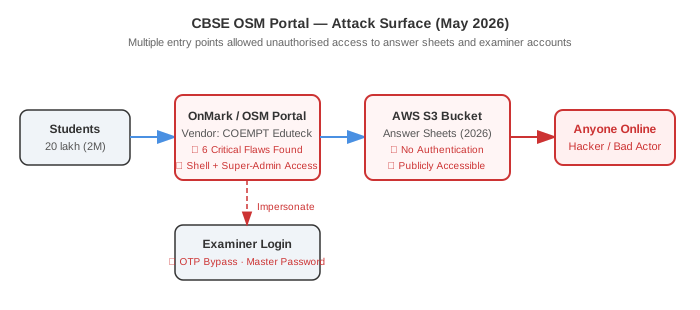
On 22 May 2026, Nisarga Adhikary — a 19-year-old ethical hacker and Class 12 student — went public on social media with a detailed breakdown of critical security flaws inside CBSE’s OnMark portal, the third-party system used by examiners to evaluate Class 12 answer sheets digitally [2][3]. What made his disclosures explosive was not just the vulnerabilities themselves, but the timeline: CBSE officials had previously denied that any such flaws existed, yet Adhikary demonstrated full create, read, update, and delete (CRUD) access along with shell access to CBSE’s live production servers [1]. He also obtained super-admin privileges on another OnMark subdomain responsible for evaluation across multiple universities [1].
The portal is operated by a private vendor, COEMPT Eduteck, under contract with CBSE. Adhikary described the system’s security posture as “insanely insecure” [4] — a characterization that even CBSE’s own subsequent audit could not convincingly refute.
Vulnerabilities Laid Bare
Adhikary identified at least six high-severity vulnerabilities across CBSE-linked systems [3]. The table below summarises the critical flaws uncovered:
| Vulnerability | Description | Risk Level |
|---|---|---|
| Hardcoded Master Password | A universal secret password embedded in publicly readable code, bypassing per-user authentication | Critical |
| OTP Exposed in Browser | One-time passwords sent to examiners visible in browser HTTP responses, making bypass trivial | High |
| Password Reset Without Verification | Any examiner’s account password could be reset with no identity check | High |
| AWS S3 Bucket — No Auth Required | Answer sheets and question papers downloadable by anyone with the bucket URL | Critical |
| MD5 Password Hashing on SARAS Portal | Outdated, easily crackable hash algorithm used on CBSE’s school affiliation system | High |
| Admin Password “123456” | An administrative portal linked to CBSE’s ecosystem reportedly used this trivial password | Critical |
Sources: [3][4][8][14]
The Amazon Web Services (AWS) S3 storage bucket linked to the OnMark system allegedly allowed anyone to browse and download scanned answer booklets and question papers from 2026 board examinations without providing any credentials [4][15]. This is a classic insecure cloud configuration — one of the most common and most preventable causes of mass data exposure in modern IT.
Impact on Students: Who Gets Hurt?
The real-world consequences of these vulnerabilities fall squarely on millions of students:
- Privacy violation: Scanned answer booklets — containing handwriting, roll numbers, and school details — were allegedly accessible to anyone with a browser and a URL [15].
- Risk of marks manipulation: The ability to impersonate examiners and gain super-admin access theoretically allowed alteration of marks, though CBSE states no such tampering has been confirmed [1][14].
- Financial fraud: A separate malicious attack on the re-evaluation portal caused fee display amounts to fluctuate wildly between ₹1 and ₹68,000, overcharging approximately 50 students [7].
- Examination integrity compromised: With 2026 question papers allegedly accessible in the AWS bucket, the fairness of the board exam itself came under a cloud [4].
- Political uproar: Congress leader Jairam Ramesh called it “a massive data leak that has put the privacy of 20 lakh students at risk,” demanding government accountability [5][6].
The COEMPT Eduteck Controversy
At the centre of the storm is COEMPT Eduteck, the private IT vendor operating CBSE’s OSM platform [17]. Critics allege that successive Requests for Proposal (RFPs) were modified across multiple tender rounds in ways that may have altered eligibility criteria to the vendor’s benefit [17]. Key red flags include:
- The requirement for robotic scanning machines — a critical physical security safeguard — was reportedly removed in the third RFP [6].
- Scanned images showed signs of being captured via mobile phone cameras rather than certified secure scanners, raising physical data-handling concerns [6].
- Congress formally demanded a probe into the tendering process and the vendor’s conduct [17].
CBSE has maintained that identified vulnerabilities “have been contained,” attributing some hacking demonstrations to a testing environment rather than live production systems — a claim disputed by cybersecurity researchers [3][10].
Fake DigiLocker: A Shadow Threat
Compounding the crisis, the Ministry of Electronics and Information Technology (MeitY) issued a public warning about a counterfeit DigiLocker website operating in the shadows of the CBSE controversy [9]. The fraudulent portal:
- Mimics the official government DigiLocker interface in look and feel.
- Claims to provide DigiLocker and CISCE services to students.
- Is engineered to harvest student credentials and personal information.
Students and parents rushing to verify board results are prime phishing targets. MeitY urges users to access DigiLocker only via digilocker.gov.in and to report suspect sites through CERT-In’s official channels [9].
Government Response So Far
The government’s immediate response has been energetic, though its long-term follow-through remains to be seen:
- IIT Task Force Deployed: CBSE brought in cybersecurity experts from IIT Madras and IIT Kanpur, alongside government agency professionals, to audit OnMark and shore up remaining vulnerabilities [11].
- Vulnerability Containment Declared: CBSE stated all “identifiable vulnerabilities” have been contained, with additional sweeps still ongoing [10].
- DigiLocker Pivot Announced: The Ministry of Education confirmed that from the next academic year, CBSE Class 12 answer sheets will move to DigiLocker, reducing dependence on third-party vendor portals entirely [16].
- National Cybersecurity Strategy 2026 Launched: This umbrella policy framework mandates coordination among CERT-In, state police cyber cells, and private sector stakeholders for faster detection and response across critical sectors [13].
- CERT-In Scale-Up: In 2024–25, CERT-In handled over 29.44 lakh cyber incidents, issued 1,530 alerts, 390 vulnerability advisories, and conducted over 9,700 security audits across government and critical infrastructure [12].
What More Must Be Done: A Policy Roadmap
Reactive patching is not a strategy. Here is what systemic reform must look like:
Mandatory Vendor Security Standards
- Any EdTech vendor handling government education data must pass a CERT-In-approved third-party security audit before contracts are signed and renewed annually.
- Security requirements in government RFPs must be non-negotiable, version-locked clauses — not items that can be quietly diluted across tender revisions.
- Formal bug bounty programmes should be established for all government education portals, giving ethical hackers like Adhikary a safe, legally protected, and financially rewarded disclosure channel.
Cloud Configuration Governance
- All government-linked cloud storage (AWS S3, Azure Blob, GCP) must undergo automated misconfiguration scanning — a standard already mandated in the EU, USA, and Australia.
- The Digital Personal Data Protection (DPDP) Act 2023 must be enforced with meaningful penalties: vendors who expose student data through negligence should face financial liability, not just advisory notices.
A Dedicated Edu-CERT
- India should establish a sectoral Education CERT (Edu-CERT) modelled on the financial sector’s CERT-Fin, with authority to independently audit, respond to, and penalise vendors operating education infrastructure in real time — without waiting for student complaints to reach newspapers.
Cybersecurity Talent Pipeline
- The National Cybersecurity Strategy 2026 targets training 5 lakh cybersecurity professionals over five years [13]; a dedicated portion must be channelled specifically into edtech security and government portal auditing.
- Cybersecurity must be added to school and college curricula so the next generation of administrators and developers builds security-first thinking from the ground up.
Student and Parent Awareness
- Annual digital literacy campaigns should educate students, parents, and school administrators on verifying official URLs, identifying phishing portals, and reporting data anomalies through official channels [9].
- CBSE should publish a clear public incident-response protocol so students know what to do the moment a breach is suspected.
The CBSE crisis is ultimately a symptom of a systemic gap: India’s rapid digital expansion in public services has not consistently been matched by equivalent investment in security architecture. As examination results, identities, and academic records become ever-more tightly bound to digital systems, the stakes only grow higher — and the window for meaningful structural reform is right now, before the next breach makes headlines.
Sources
- CBSE Online Marking Portal Hacked After Officials Denied Security Flaws — MediaNama
- How a 19-year-old student hacked CBSE’s OSM portal, exposed vulnerabilities — The Print
- CBSE admits vulnerabilities in OnMark portal after teen hacker alleges answer sheet leak — Careers360
- ‘Insanely insecure’: Ethical hacker alleges CBSE answer sheets were publicly accessible — BusinessToday
- CBSE Class 12 data leak: 20 lakh students’ privacy at risk, says Cong — Asianet Newsable
- Massive data leak that has put privacy of 20 lakh students at risk: Congress slams government — ANI News
- CBSE Portal Faces Malicious Attack Affecting Approximately 50 Students — The Chenab Times
- ‘Password was 123456’: Student alleges fresh security lapses in CBSE-linked systems — BusinessToday
- Govt warns students about fake DigiLocker website amid CBSE OSM row — Digit
- CBSE says OSM portal ‘vulnerabilities contained’, deploys IIT teams for cybersecurity review — India TV News
- CBSE Deploys IIT Madras and IIT Kanpur Experts After Security Concerns Over OnMark Portal — Swarajya Mag
- Government Strengthens Cybersecurity Across Critical Sectors; Over 9,700 CERT-In Audits Conducted in 2024–25 — PIB
- India Launches National Cybersecurity Strategy 2026 — Education Post
- CBSE OSM Controversy Explained: Board Admits Security Gaps After Portal Was Hacked — Gulf News
- CBSE Answer Sheet Leak Row: Students Allege AWS Data Breach, Poor Scanning and Evaluation Errors — OneIndia
- From next year, CBSE Class 12 answer sheets to be available on DigiLocker — Careers360
- Congress raises alarm over alleged CBSE answer sheet leak, questions evaluation contractor — The Statesman