
Amazon didn’t set out to build the world’s largest cloud platform. It stumbled into one while trying to stop its own engineers from reinventing the same infrastructure wheel every few months.
The Internal Mess That Started It All
Around 2000, Amazon was building Merchant.com — a product to let third-party retailers like Target and Marks & Spencer spin up e-commerce stores on Amazon’s infrastructure [2]. What followed was an organizational disaster. Every team was independently building its own version of the same storage, compute, and database primitives. No shared APIs, no standard way to access anything.
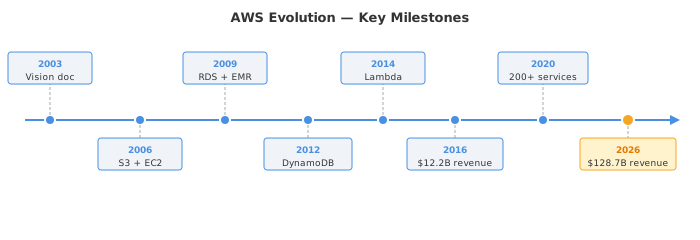
So they did what Amazon does: they wrote a document. In the summer of 2003, at an executive offsite at Jeff Bezos’ house, the leadership team ran an exercise to identify the company’s core competency. The answer was building reliable, scalable, distributed systems [2]. Andy Jassy — then a VP, now Amazon’s CEO — saw the obvious next step. He wrote the original AWS vision document, requesting 57 people to start building what he called “an operating system for the internet” [2].
That document became AWS.
The First Services (2004–2006)
Here’s something most people get wrong: SQS was the first public AWS service, not S3 or EC2 [6]. Amazon Simple Queue Service launched in preview in November 2004 — over a year before storage or compute existed publicly. Makes sense if you think about it. Amazon needed a way to decouple its own internal services before it could offer anything else.
Then came the two services that actually changed the industry:
- Amazon S3 (Simple Storage Service) — launched March 14, 2006. Object storage at scale, pay only for what you use [3]
- Amazon EC2 (Elastic Compute Cloud) — preview August 24, 2006; went generally available October 2008 [3]
Before EC2, a startup had to buy or lease physical servers, provision them, rack them, and pray the traffic estimates weren’t wrong. After EC2, a developer with a credit card could get as much compute as they needed in minutes [1]. The economics of building software shifted permanently.
Three years after launch, AWS had a $58 million annual run rate [3]. Small by today’s numbers, but the direction was unmistakable.
Building the Real Platform (2007–2012)
AWS spent these years turning “cheap compute and storage” into a proper cloud platform. The missing pieces came one by one:
- Amazon CloudFront (2008) — CDN for edge delivery worldwide [3]
- Amazon RDS (2009) — managed relational databases; no more babysitting MySQL on raw EC2 [3]
- Amazon EMR (2009) — Hadoop clusters on demand, aimed at data teams [3]
- Amazon VPC (2010) — Virtual Private Cloud, isolated networking inside AWS [3]
- Amazon DynamoDB (2012) — NoSQL at scale, born from Amazon’s own shopping cart architecture [4]
- Amazon Redshift (2012) — petabyte-scale data warehousing [3]
The database services were particularly significant. Before RDS, companies were either paying Oracle a fortune or self-managing MySQL on raw EC2 instances and praying nothing went wrong at 2am. AWS absorbed that entire problem.
The Serverless Shift (2013–2016)
AWS re:Invent 2014 was the moment the industry moved again. AWS Lambda launched — the idea that you don’t need to think about servers at all, just upload a function and pay per invocation [3]. Serverless as a concept didn’t exist before Lambda made it real and practical.
The enterprise gaps were filling in at the same time:
- Amazon Aurora (2015) — MySQL/PostgreSQL-compatible but with a custom storage engine, claimed 5× the performance of standard MySQL [3]
- AWS CloudTrail (2013) — audit logging, which turned out to be non-negotiable for compliance teams
- AWS Certificate Manager (2016) — free TLS certificates; goodbye Symantec invoices
In 2015, AWS became Amazon’s most profitable business unit — more profitable than the retail operation that had put Amazon on the map in the first place [4]. That was a genuine turning point. A side project to reduce internal chaos had become the engine funding everything else.
By 2016, AWS revenue hit $12.2 billion [3].
The Platform Matures (2017–2022)
By this point AWS had stopped being “cloud compute” and become something closer to a complete operating environment for enterprises. Key additions:
- Amazon SageMaker (2017) — a managed ML platform that removed the need to set up training infrastructure from scratch [5]
- AWS Fargate (2017) — serverless containers; Lambda but for Docker workloads
- Amazon EKS (2018) — managed Kubernetes, after it became clear engineers were running it on EC2 anyway
- AWS Ground Station (2019) — satellite communication as a managed service [3]
The strategy became obvious: identify every piece of infrastructure a company might need and build a managed version of it. Databases, queues, streaming, video transcoding, IoT, ML, blockchain, even quantum computing simulation. By 2020, the count crossed 175 services [3]. They weren’t stopping.
The AI Push (2023–Now)
The generative AI wave caught every cloud provider off-guard in terms of speed, but AWS moved quickly:
- Amazon Bedrock — a managed API layer for foundation models: Anthropic’s Claude, Meta’s Llama, Mistral, and others. Build AI apps without managing model infrastructure at all [5]
- Amazon SageMaker AI (2024 redesign) — rebuilt as a unified data and AI studio, cutting model training workflows from months to days [5]
- Amazon Nova — AWS’s own family of foundation models, announced at re:Invent 2024 [5]
AWS’s AI revenue run rate crossed $15 billion in early 2026 [9]. The compound effect of 20 years of infrastructure investment is showing up clearly in these numbers.
Where It Stands Today
| Metric | 2026 figure |
|---|---|
| Annual revenue (2025) | $128.7 billion [7] |
| Cloud market share | ~32% [8] |
| Total services | 200+ [3] |
| Global regions | 36 [3] |
| Availability Zones | 100+ [3] |
| Countries served | 245 [3] |
| Price reductions since 2006 | 129 times [3] |
Azure is at ~23% and growing. Google Cloud holds ~11% [8]. AWS leads but the gap is narrower than five years ago — Microsoft’s OpenAI integration has pulled significant enterprise workloads toward Azure, and that competition will only get more interesting.
What’s hard to fully absorb is the trajectory. A 2003 internal document requesting 57 people to build shared APIs became a business generating more revenue than most countries’ GDP. And the original reason for building it was just to stop internal teams from duplicating work.
End
Sources
- Our Origins – Amazon Web Services
- How AWS came to be – TechCrunch
- Timeline of Amazon Web Services – Wikipedia
- The Remarkable History of AWS – TechAhead
- AWS Unveils Next-Generation Amazon SageMaker – Amazon Press
- What Was the First AWS Service? – Peakscale
- AWS Statistics 2026: Revenue & Operating Income – ExpandedRamblings
- Cloud Market Share 2026: AWS vs Azure vs Google – BusinessTats
- AWS at 20: Inside the Rise of Amazon’s Cloud Empire – GeekWire