
The “just scale microservices” question keeps coming up whenever Spark enters the conversation. It sounds logical — you already have distributed services, just throw more at the problem. But this comparison collapses under a pretty basic question: what kind of problem are you actually solving?
It Is Not a Database. Not a Queue.
People come to Spark expecting something like a faster database or a smarter Kafka. Neither is accurate.
Apache Spark is a unified analytics engine for large-scale data processing — designed to run on single-node machines or full clusters, handling data engineering, data science, and machine learning workloads from the same runtime. [1] In practice: you hand it a dataset — could be 50GB, could be 50TB — and it automatically splits the work across machines, runs computations in parallel, mostly in memory, and returns a result.
That “mostly in memory” part is the whole game. Traditional Hadoop MapReduce wrote intermediate results to disk after every single computation step. Spark keeps them in RAM where possible, avoiding that disk I/O on every round-trip. The performance difference is not marginal — Spark runs up to 100x faster than Hadoop for iterative workloads and 10x faster on disk-based jobs. [2] Yahoo benchmarked both frameworks on large-scale datasets and found Spark completing jobs up to 20 times faster than MapReduce. [11]
It supports Java, Scala, Python, and R. [3] Batch jobs, streaming, SQL queries, machine learning, graph processing — all from the same engine. That is why they call it “unified.” You are not stitching together five separate tools for five separate workloads.
How It Actually Works
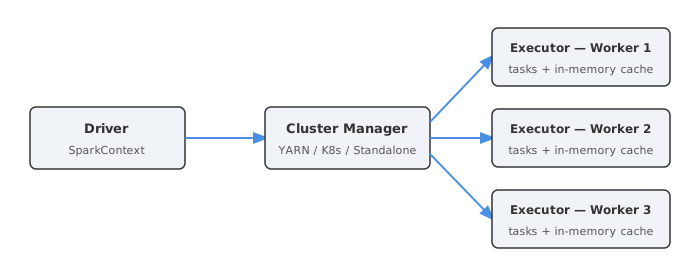
Spark runs on a Driver-Executor model coordinated by a Cluster Manager. [5] Three pieces:
- Driver — your application code lives here. The Driver creates a
SparkContext, translates your logical plan into a physical execution plan, optimizes it into stages, and distributes tasks to workers. [6] - Cluster Manager — allocates CPU and memory across the cluster. Spark supports its own Standalone mode, Hadoop YARN, Kubernetes, and Apache Mesos. [5]
- Executors — worker processes running on each node. They carry out the tasks, perform the actual transformations, and cache intermediate data in memory. [6]
The other critical piece is RDDs — Resilient Distributed Datasets. [12] An RDD is an immutable, fault-tolerant collection of records distributed across nodes and processed in parallel. Spark tracks the full lineage of every RDD — every transformation that was applied to produce it, represented as a Directed Acyclic Graph (DAG). [4]
If a worker node dies mid-job, Spark does not restart from scratch. It follows the lineage graph and recomputes only the lost partitions. [12] That failure recovery is fully automatic. You write zero recovery code.
So Can’t You Just Scale Microservices?
Here is the honest answer.
For most application workloads — API requests, user authentication, CRUD operations — horizontal microservice scaling is exactly the right move. More pods, load balancer in front, done. I am not arguing against that.
The problem appears when data volume becomes the bottleneck, not request concurrency.
Say you want to run a fraud detection job over 6 months of transaction records — 400 million rows. Your payment microservice cannot do that. Even if you spin up 50 instances of it, each one is designed to handle one request at a time. There is no built-in mechanism to:
- Split 400 million rows across those 50 instances
- Track which rows have been processed and which haven’t
- Handle a node failure mid-job without losing work
- Merge and aggregate partial results at the end
You would have to build all that coordination logic yourself. Spark is that coordination logic. Already built, battle-tested, and running in production at Netflix, Uber, Amazon, and hundreds of other companies. [9]
There is also a thing people miss completely — scaling microservices scales request throughput, not data throughput. More instances means you can handle more concurrent users. But all those instances are still reading from the same database. That database becomes the chokepoint, not the service tier. [10] Spark sidesteps this by reading data directly from HDFS, S3, or a data lake, processing it in-place across the cluster, without routing every record through a shared transactional database.
A research paper integrating Spark with cloud-native microservices deployed on Kubernetes found that the combined framework reduced processing latency by up to 83.1% versus monolithic deployments. [8] Microservices handled the API and routing layer. Spark handled the data computation. They worked together — not in place of each other.
| Scaling Microservices | Apache Spark | |
|---|---|---|
| Problem solved | Request concurrency | Data volume |
| Unit of scale | Service instance | Data partition |
| State between steps | Stateless by design | Lineage-tracked RDDs |
| Failure recovery | Restart the container | Recompute lost partitions |
| Data location | Shared relational DB | Distributed file system / data lake |
| Job duration target | Milliseconds per request | Seconds to minutes per full dataset |
What Companies Are Actually Doing With It
Netflix uses Kafka + Spark Streaming to process billions of events per day from viewer interactions. [9] Their pipeline drives real-time personalization, and they have reported a 10–20% improvement in viewer engagement from the precision of those recommendations. [9]
Uber runs Spark to monitor over 15 million trips daily — real-time ride requests, driver locations, surge pricing, route optimization, demand forecasting. [9] All Spark pipelines.
NVIDIA uses Spark specifically to merge telemetry and logs from their own microservices at scale. [13] That is worth noticing: a company running microservices heavily still needs Spark to make sense of the data those services generate.
Both Netflix and Uber run thousands of microservices alongside Spark. Those microservices consume Spark results. They do not replace it.
When You Probably Do Not Need Spark
Not every data problem is a Spark problem.
If your dataset fits on one machine and runs in a few minutes with plain SQL or Pandas, Spark adds operational overhead with zero benefit. Cluster management, resource tuning, partition sizing, executor memory configuration — it is not a weekend setup. [7]
A rough heuristic:
- Under a few hundred GB, batch, no real-time requirement → a decent database with SQL is fine
- Hundreds of GB to TB range, regular batch jobs → Spark starts making sense
- TB+ or real-time streaming at scale → Spark is the standard answer for a reason [1]
The cost side is also non-trivial. Without understanding partitioning and memory management, you can easily end up paying for a Spark cluster that runs slowly and expensively. [10] It rewards people who understand how it works internally — not just people who pip install pyspark.
End
Sources
- Apache Spark — Unified Engine for large-scale data analytics
- What is Spark? — Introduction to Apache Spark and Analytics — AWS
- What Is Apache Spark? — IBM
- Apache Spark — Wikipedia
- Apache Spark Architecture 101: How Spark Works (2026) — Flexera
- Apache Spark Architecture: Complete Guide with Execution Flow — Medium / Towards Data Engineering
- Java Microservices and Big Data: Integrating Apache Spark — SpringFuse
- Integrating Apache Spark with Cloud-Native Microservices for Scalable Data Processing — ResearchGate
- 10 Powerful Apache Spark Use Cases Across Industries — upGrad
- How to Scale Apache Spark Clusters for Massive Datasets — Datatas
- Apache Spark vs Hadoop MapReduce — Feature Wise Comparison — DataFlair
- What Is a Resilient Distributed Dataset (RDD)? — IBM
- Merging Telemetry and Logs from Microservices at Scale with Apache Spark — NVIDIA Technical Blog