
The line between frontend developer and AI engineer is blurring fast. In 2026, the most in-demand web developers aren’t just crafting beautiful UIs—they’re wiring those UIs directly to large language models, vector databases, and autonomous agents. If you already know React, TypeScript, or Next.js, you are far closer to that future than you might think.
Why Frontend Developers Have a Head Start
The modern AI application stack runs on TypeScript, React, and HTTP APIs—the exact tools you already use every day [1]. Frameworks like Next.js have become the default output of AI-powered UI builders, and the Vercel AI SDK is already a first-class citizen in the React ecosystem [2]. Unlike data scientists who must first learn deployment and UI, you already know how to ship products. Your challenge isn’t learning how to build—it’s learning which new primitives to build with.
Key advantages you bring from day one:
- Component thinking maps directly to agentic tool design and modular AI workflows
- API consumption (REST, GraphQL) transfers naturally to LLM API calls and streaming responses
- State management skills apply directly to multi-turn conversation memory
- TypeScript is the dominant language in production AI application layers [3]
Your 6-Phase AI Roadmap
The journey from frontend developer to AI-capable engineer takes roughly 6–12 months, depending on learning pace [4]. The critical principle: build something real at every phase. Watching tutorials without shipping is the single biggest time-waster in AI learning [4].

Phase 1 — Adopt AI-Powered Dev Tools (Month 1)
Before writing a single line of AI code, start using AI every day. This builds intuition for what models can and cannot do—intuition that pays dividends in every later phase [5].
Tools to adopt right now:
- GitHub Copilot – inline autocomplete for HTML, CSS, JavaScript, and all major frameworks including React, Vue, and Angular [5]
- Cursor – conversational code editing inside your IDE
- Vercel v0 – generate production-ready React + Tailwind components from plain-text descriptions [5]
- Codeium – the strongest free alternative for autocomplete and code suggestions [5]
Important caveat: In your first month, write components manually before accepting AI suggestions. Letting AI generate large code blocks too early stunts the pattern recognition that makes you a better engineer and a better prompt writer later [1].
Phase 2 — Integrate LLMs Into Your Apps (Months 1–3)
This is where your existing skills begin to compound. Learn to call LLM APIs directly from React or Next.js.
Start with the Vercel AI SDK. It is an open-source TypeScript toolkit that provides a unified interface across all major providers—OpenAI, Anthropic, Google Gemini, and Mistral—so you can swap models by changing just two lines of code [2]. It handles streaming, tool calling, and generative UI out of the box, making it the most frontend-native entry point into AI development [2].
| Provider | Package | Strengths |
|---|---|---|
| Vercel AI SDK | ai (npm) | Unified API, Next.js-native, streaming UI |
| OpenAI | openai (npm) | General-purpose chat and function calling |
| Anthropic | @anthropic-ai/sdk | Long context, complex reasoning |
| Google Gemini | @google/generative-ai | Multimodal (text + image + audio) |
Core skills to nail in this phase:
- Streaming responses live into the UI
- Structured JSON output with schema validation
- Multi-turn conversation with message history
- Basic tool/function calling
Codecademy’s AI-Assisted Front-End Development path teaches you to build React apps using AI coding agents while explaining how these tools work under the hood—a useful companion for this phase [6].
Phase 3 — Master Prompt Engineering (Months 2–4)
Prompt engineering is no longer the ceiling of AI expertise—it is the floor [7]. Every AI engineer needs it, and without it, every downstream phase becomes harder.
Five core techniques to internalize:
- System prompts – define the model’s persona, constraints, and output format before any user input
- Few-shot examples – show 2–5 example input/output pairs to reliably guide behavior
- Chain-of-thought (CoT) – instruct the model to reason step-by-step before delivering a final answer
- Structured output – use JSON schemas or Zod validation to guarantee parseable responses every time
- Temperature control – tune creativity vs. determinism depending on the use case (creative copy vs. code generation)
Build a small real project—a content generator, a smart form, a code reviewer—while practicing these techniques. Learning only sticks when you build at the same time [4].
Phase 4 — Build RAG Systems (Months 3–6)
Retrieval-Augmented Generation (RAG) lets your AI app answer questions grounded in your own data—product docs, knowledge bases, support tickets—rather than the model’s static training data. It is one of the most consistently high-value skills in the 2026 job market [7].
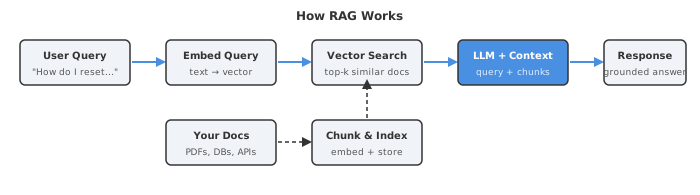
Frontend-friendly vector database options:
- Supabase + pgvector – PostgreSQL-based vector store; familiar if you already use Supabase
- Pinecone – fully managed, clean REST API, minimal infrastructure
- Upstash Vector – serverless and edge-compatible, pairs well with Vercel deployments
The skill shift in 2026 is from basic RAG (search once, summarize) to agentic RAG (search iteratively, validate sources, combine findings) [7]. Basic RAG now is the foundation for Phase 5.
Phase 5 — AI Agents and the MCP Protocol (Months 5–9)
AI agents are applications where the model decides which tools to call and in what order, rather than following a fixed execution path. This is the fastest-growing area of AI engineering in 2026 [8].
Key concepts to build:
- Tool calling – give the model access to typed functions (search, calculator, database queries, API calls)
- Agentic loops – the model calls a tool, observes the result, then decides the next step
- Multi-agent coordination – specialized agents collaborating on a shared task
The MCP Protocol is now the universal standard for connecting AI agents to tools and data sources. Donated to the Linux Foundation in late 2025, it was rapidly adopted by OpenAI, Google, Microsoft, and Amazon within months [7]. For frontend developers, MCP means your Next.js app can expose structured tool interfaces to any LLM using one standardized protocol—no more bespoke integrations per provider.
Frontend Masters’ Coding with AI path covers the complete agentic loop, model trade-offs, skills, hooks, and building agent teams—exactly aligned with what hiring managers screen for today [9].
Phase 6 (Optional) — Python and ML Foundations (Months 6–12)
If your goal is to move deeper into AI engineering—fine-tuning models, working with embeddings at scale, or joining a dedicated ML team—Python becomes essential. It covers approximately 90% of work in AI engineering and data science roles [4].
Where to invest Python time:
numpyandpandasfor data wranglingtransformers(Hugging Face) for open-source model access- LangChain or LlamaIndex for production RAG and agent pipeline orchestration
This phase is optional for frontend developers who want to stay in the application layer. Skipping it does not limit you; most high-value AI product work in 2026 is in TypeScript.
Top Learning Platforms in 2026
| Platform | Course / Path | Best For |
|---|---|---|
| Frontend Masters | Coding with AI | Agents, Claude Code, LLM workflows |
| Codecademy | AI-Assisted Front-End Dev | React + AI tools from scratch [6] |
| DataCamp | AI Learning Roadmap 2026 | Broad AI fundamentals and Python [4] |
| Coursera | GenAI for Front-End Developers | GenAI concepts for web developers |
| Dataquest | AI Engineer Roadmap | Full stack → AI engineer transition [3] |
| Capgemini Academy | GenAI for Front-End Devs | Ethics, Copilot, enterprise AI use |
Skills That Get You Hired in 2026
Recruiters screening AI-capable frontend developers in 2026 are working from a very specific checklist [7] [8]:
- LLM API integration with at least one major provider (OpenAI, Anthropic, or Gemini)
- Vercel AI SDK or equivalent unified-interface tooling
- Prompt engineering with structured output and few-shot techniques
- RAG system design including chunking strategy and re-ranking
- Agent orchestration with tool use and multi-step agentic loops
- MCP protocol awareness and practical implementation
- Eval literacy – designing and running model evaluations to measure quality
- Safety and guardrails – scoping agents so they cannot take unauthorized actions
The biggest skill gap in the market today isn’t model knowledge or math—it’s agentic engineering: designing and operating AI agents that reliably survive in production [8]. That single capability is what separates developers who consumed tutorials from those who have shipped real AI products.
Start with the tools you use every day, ship something small in month one, and let each phase compound on the last. The path from React developer to production-ready AI engineer in 2026 has never been shorter—or more worth taking.
Sources
- Learn Frontend Development in 2026 | ASSIST Software
- AI SDK by Vercel – Introduction
- AI Engineer Roadmap 2026: Skills for Full-Stack Developers | Imaginary Cloud
- A Realistic Roadmap to Start an AI Career in 2026 | Towards Data Science
- 7 Best AI Tools for Frontend Development in 2026 | eesel AI
- AI-Assisted Front-End Development | Codecademy
- AI Developer Hiring 2026: Skills That Actually Matter | Digital Applied
- Agentic AI Skills Required for Engineers & Developers 2026 | NovelVista
- Coding with AI Learning Path | Frontend Masters